





If you like our site, mark us as a preferred source on Google — so you’ll see our articles more often in search!
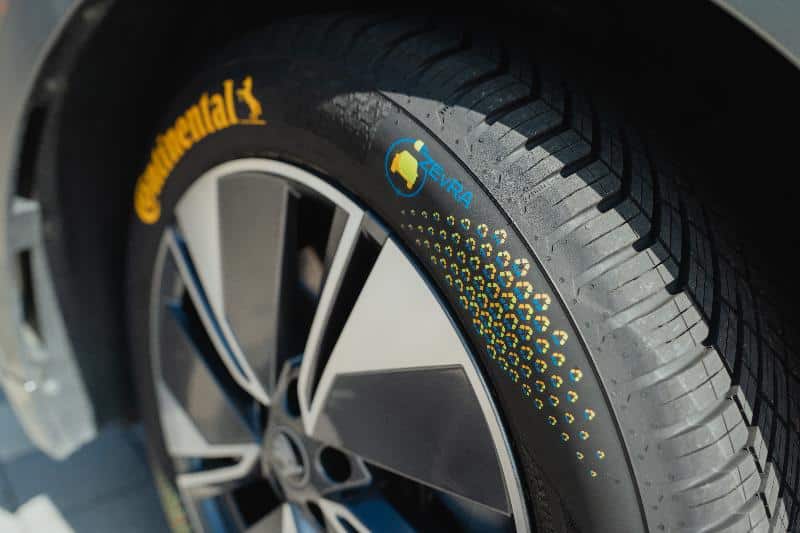
★Mark us as a preferred sourceThe usage of Continental recycled materials has reached a new milestone within the EU-funded ZEvRA project. The company has developed a concept tire containing over 43 percent recycled content, demonstrating the significant potential of circular value chains for electric cars.
The ZEvRA project and the role of Continental recycled materials
ZEvRA, which stands for “Zero Emission Electric Vehicles Enabled by Harmonized Circularity,” is a two-year EU project concluding in 2026. Its primary goal is to optimize the circular economy of electric vehicles across the entire value chain. Out of the 28 project partners, Continental is the only tire manufacturer. This unique position allows the company to test and integrate a higher proportion of Continental recycled materials while paving the way for future sustainable mobility solutions on a global scale.
Recycled components and advanced extraction processes
The newly introduced concept tire is comprised of around 43 percent recycled materials. These components include recycled tall oil, steel, rubber from end-of-life tires, and polyester fibers derived from recycled PET bottles. Furthermore, the manufacturer utilizes technologies such as pyrolysis to extract materials like recovered carbon black (rCB) from end-of-life tires. This specific technology has been employed since 2023 at the Korbach production site in newly manufactured solid rubber tires, which are primarily fitted on forklift trucks. Another key process involves using sand that forms as a residue in foundries (rSand) to manufacture an alternative silica variant, completely replacing the need for primary raw materials in this aspect.
High performance without compromise
Integrating a large volume of Continental recycled materials into a safety-critical product without compromising on performance is a significant challenge. Tires require precisely balanced, high-performance raw materials to ensure safety, efficiency, and longevity. Despite these complex technical requirements, the concept tire proves that sustainability and performance are highly compatible by achieving the highest rating on the EU rolling resistance label. Dr. Andreas Topp, head of Platform Development and Industrialization for passenger-car tires at Continental, noted that circular materials save resources and energy while reducing greenhouse gas emissions, serving as a catalyst for tomorrow’s innovations.
Regulatory frameworks for industrial-scale recycling
While some recycling solutions like recovered carbon black are already in effective use, many processes are still undergoing industrialization. Dr. Topp emphasizes that reliable, aligned regulatory frameworks are essential to provide planning certainty and support the market ramp-up of new processes. This requires standard European-wide definitions and clearly defined criteria for recycled materials. Jorge Almeida, head of Sustainability for Continental’s Tires group sector, added that establishing innovative recycling technologies on an industrial scale with closed material flows is the next critical step. This transition demands a standardized calculation and reporting approach developed through close dialogue between policymakers and stakeholders, focusing on transparency and simplicity for consumers.
Additional sustainable inputs and 2030 targets
Beyond the 43 percent recycled content, the concept tire contains approximately 13 percent renewable raw materials and a further 25 percent mass-balance-certified materials. Consequently, more than 80 percent of the overall materials used in the ZEvRA concept tire originate from recycled, renewable, or mass-balance-certified sources. Continental has been actively increasing these shares: since 2022, polyester from recycled PET bottles has been used in selected tires, and the UltraContact NXT (launched in 2023) features up to 65 percent sustainable materials. As of 2025, the share of purchased renewable and recycled production materials in Continental’s portfolio was 28 percent, with a firm target to increase this to at least 40 percent by 2030.

FAQ
What is the ZEvRA project?
ZEvRA is a two-year EU project ending in 2026, aimed at optimizing the circular economy of electric vehicles. Continental is the sole tire manufacturer among its 28 partners.
What recycled materials are used in the Continental concept tire?
The tire contains 43 percent recycled materials, including tall oil, steel, rubber from end-of-life tires, polyester from recycled PET bottles, and recovered carbon black (rCB).
What are Continental’s sustainability targets for 2030?
Continental aims to increase the share of purchased renewable and recycled production materials in its tire portfolio from 28 percent in 2025 to at least 40 percent by 2030.
Reference link:
Continental Official Press Release (Original Source)
Consistent structure, quick answers: every article is built so that both readers and AI search tools can find the key points easily. Our content is produced with the help of AI tools and reviewed by our editor.
