




If you like our site, mark us as a preferred source on Google — so you’ll see our articles more often in search!
★Mark us as a preferred sourceIn short: Funded by an Innovate UK scheme, Kingston University leads the new National Waste and Recycling Robotics Adoption Hub (NORAH) to accelerate the deployment of waste management robotics in real-world facilities.
The implementation of waste management robotics takes a significant step forward as Kingston University has been selected to lead the UK’s first dedicated robotics adoption hub. Backed by a £40 million government scheme funded by Innovate UK, this initiative aims to transform the circular economy through advanced automation.
The core of waste management robotics: The NORAH Project
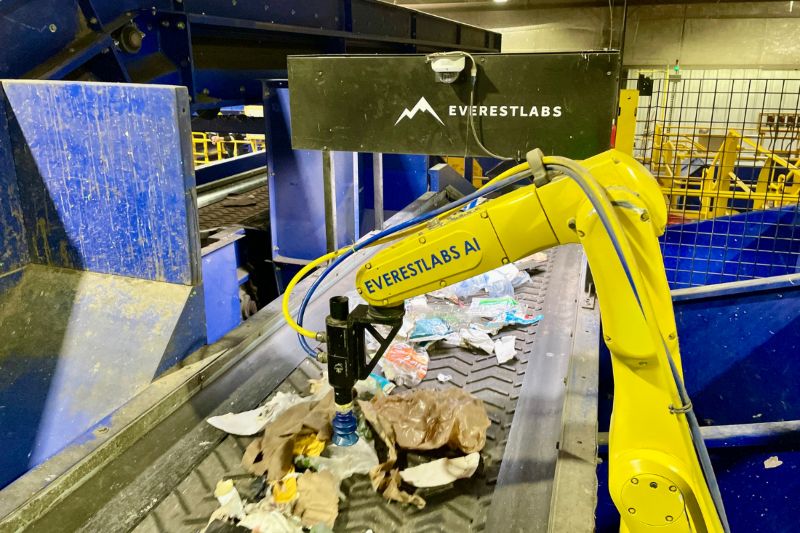
The £3.6 million National Waste and Recycling Robotics Adoption Hub (NORAH) project will see £1.5 million allocated directly to Kingston University. Based in the Southeast of England, it is one of eight such robotic hubs nationwide. Led by Professor Vasilis Argyriou, a recognised expert in AI and computer vision, the initiative focuses on pushing automated sorting systems out of the laboratory and into active industrial implementation to recover more materials and reduce landfill usage.
Addressing current industrial limitations
Currently, fewer than five percent of UK waste facilities utilise automation. Traditional robotic systems struggle to perform reliably when dealing with contaminated, heterogeneous, and deformable materials. As a result, facility operators cannot confidently predict their return on investment. NORAH addresses this gap by testing technologies directly on live, contaminated waste streams. Initial testing prioritises complex items like textiles, soft-material waste, and mixed recyclables—challenges that resonate closely with broader plastic recycling challenges documented globally.
Goals and extensive partnerships by 2030
Using multi-arm robotic sorting cells, advanced sensing systems, and digital simulation, the hub will generate empirical data on classification accuracy, throughput, and contamination handling. The project consortium includes the University of Kent, the West London Waste Authority, alongside various robotic developers and local authorities. By 2030, Professor Argyriou intends to support over 150 organisations, delivering live operational deployments, keeping valuable materials out of landfills, and creating highly skilled jobs. For original reference, visit the Kingston University announcement or the Innovate UK government portal.
FAQ
What is the primary objective of the NORAH project?
The main objective is to help UK waste and recycling sites test, validate, and confidently adopt robotics systems on real waste streams to increase material recovery and productivity.
Why is automation adoption currently low in UK waste facilities?
Fewer than 5% of facilities use automation because current robotic systems often struggle with reliable performance when handling contaminated, heterogeneous, and deformable waste.
Which materials are the initial focus for these new robotic systems?
The hub initially focuses on complex and challenging materials where productivity gains are highest, such as textiles, mixed recyclables, and soft-material waste.
Consistent structure, quick answers: every article is built so that both readers and AI search tools can find the key points easily. Our content is produced with the help of AI tools and reviewed by our editor.
