





If you like our site, mark us as a preferred source on Google — so you’ll see our articles more often in search!
★Mark us as a preferred sourceOn 26 October 2026, the European Commission’s science service, the Joint Research Centre (JRC), published its technical proposal on when textile, textile-related and footwear waste should cease to be waste across the EU. End-of-waste criteria for textiles have so far been set nationally, if at all, leaving operators with very different rules from one country to the next. What makes this proposal new is its focus: for the first time, EU-wide end-of-waste criteria are being drafted not for recycling but for preparing for re-use and for remanufacturing. We looked at what it contains, who would have to do what, and what it could mean for textile collection in Hungary.
In short: The JRC proposes end-of-waste criteria for textiles under which a sorted, and where needed cleaned or repaired, textile or footwear item stops being waste once it meets all requirements and can go onto the second-hand market without further processing. Items unfit for re-use that are remanufactured would have a separate route out of waste status, backed by a quality management system and a statement of conformity.
What exactly has the JRC put on the table?
The document builds on Article 6 of the Waste Framework Directive (2008/98/EC), which ties end-of-waste status to four general conditions: the object is used for a specific purpose, a market or demand exists for it, it meets the technical requirements, legislation and standards applicable to products, and its use will not lead to overall adverse environmental or human health impacts. The Directive also requires EU-level criteria to cover input materials, treatment processes, quality requirements, management systems and a statement of conformity. The JRC proposal fills exactly these five blocks with content.
Its legal status matters: this is a technical proposal, not legislation. The JRC states explicitly that the Commission’s Directorate-General for Environment (DG ENV) may decide to begin work on an implementing act, but drafting the proposal implies no commitment, and the Commission is free to depart from it in any future regulation.
Textiles were not picked at random. In the Commission’s earlier scoping study on which waste streams merit EU-wide criteria, textiles ranked second, after plastics. Criteria for textile recycling are covered in a separate JRC report; this one deals only with sorting, preparing for re-use and remanufacturing.
Why does the EU need a single rulebook?
According to the JRC’s mapping, only two member states currently have end-of-waste provisions for textiles prepared for re-use. France has had a ministerial order since 2018 defining when objects sorted for re-use stop being waste, and Austria has published a guidance document on the same question. No member state has criteria specifically for remanufacturing. Hungary does not appear in the mapping as a country with textile-specific end-of-waste rules.
The practical consequence is legal uncertainty. The same sorted, wearable coat can be a product in one country and still waste in another, with different permitting, shipment and record-keeping obligations attached. This affects sorting plants, second-hand traders, charities and remanufacturers alike. In the JRC’s view, harmonised criteria would remove this fragmentation and open the market for high-quality second-hand and remanufactured goods.
The pressure is growing. The 2025 targeted amendment of the Waste Framework Directive (Directive (EU) 2025/1892) makes extended producer responsibility (EPR) for textiles mandatory across the EU, and separate collection of textiles has been compulsory in every member state since 1 January 2025. More collected textiles mean more material to sort, and the system only works if it is clear when a sorted garment becomes a product again.
Which textiles would be covered?
The scope covers three sources:
- post-consumer household textile waste: clothing, accessories, footwear, home textiles and other items made wholly or partly of textiles;
- post-consumer commercial textile waste: for example from hospitality, healthcare, agriculture or construction, including technical textiles;
- pre-consumer textile waste: excess stock, returns and unsold goods arising at retail level.
In principle all textile and footwear categories are included, but bulky items are excluded. These include mattresses and mattress toppers, filled bedding such as duvets and pillows, foam-filled garden cushions, large carpets and rugs that do not fit standard collection containers, and upholstery.
Two further restrictions stand out:
- Mixed municipal waste is excluded. Textiles destined for re-use or remanufacturing may come from any source except mixed municipal solid waste. Textiles recovered from residual waste therefore cannot leave waste status by this route.
- A negative list. Healthcare textiles, carpets and rugs, reusable absorbent hygiene products, and technical textiles including protective footwear must be removed from the re-use and remanufacturing streams. For these, recyclability is to be assessed first.
Where qualified staff have reasonable grounds to suspect that an item contains substances restricted under REACH or the POPs Regulation, it must be redirected to recycling or other recovery.
End-of-waste criteria for textiles: when does a used garment become a product again?
The proposal sets out two separate routes.
1. Preparing for re-use. A textile, textile-related or footwear item ceases to be waste when it
- has undergone sorting for re-use and, where needed, preparing for re-use,
- complies with the full set of criteria, and
- is ready to be placed on the second-hand market without any further processing.
2. Remanufacturing. An item judged unsuitable for re-use can also leave waste status if it
- has undergone a remanufacturing operation,
- complies with the criteria for remanufacturing, and
- is ready to be placed on the market again without further processing.
In practice, the meaning of “further processing” decides where the line falls, so the JRC clarified it. Routine preparation steps such as cleaning, minor repairs, ironing, labelling and packaging do not affect end-of-waste status. Further processing, by contrast, means extensive repairs requiring replacement of major components such as zips or linings, resizing or altering garments, or re-dyeing and re-finishing, because these change the nature or intended function of the item.
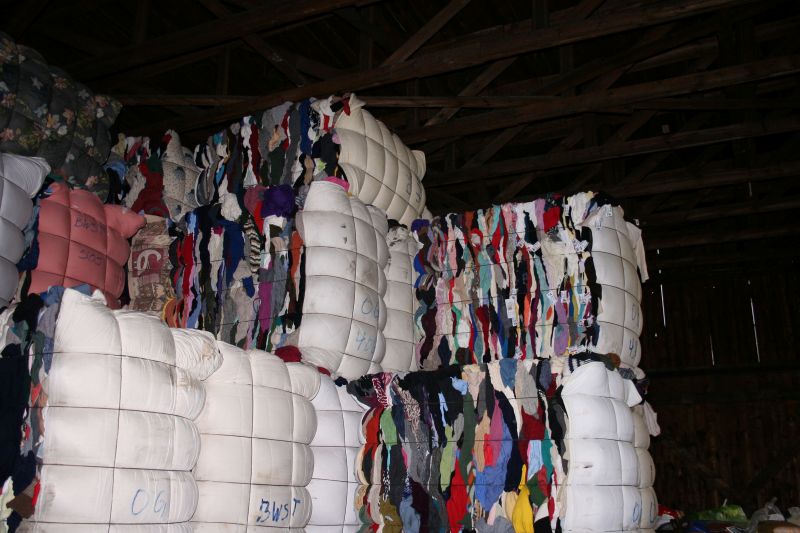
Stakeholder feedback shaped this boundary. Many pointed out that used clothing exported for re-use typically travels in compressed, unwashed bales and is washed and ironed in the destination market before resale. If such steps counted as “further processing”, end-of-waste status would in practice never be reached.
Five sets of requirements, from the sorting floor to the paperwork
Input materials. All incoming textiles must go through a preliminary sorting step to remove non-textile items, followed by sorting for re-use. An item is fit for direct re-use if it shows no excessive wear, does not smell unpleasant, shows no signs of dirt and is not missing parts critical to its use. Minor faults, such as a missing button, are acceptable. Acceptance control relies on visual, tactile and olfactory inspection, but automated systems offering equivalent verification are also accepted.
Treatment processes. Compliant items must be kept separate from non-compliant material, and rejects labelled as waste. Items unfit for re-use go preferably to remanufacturing wherever possible, otherwise to recycling. Bales must be labelled so that the next holder does not need to re-sort them. Footwear must be cleaned or sanitised where appropriate.
Product quality. Output items must not give off persistent unpleasant odours or show dirt, must be functional, and must meet all legal requirements as well as customer, industry or standard specifications. Compliance is verified at batch level through proportionate, risk-based checks rather than item by item. Non-textile materials (paper, wood, plastic, metal, stone, ceramics) must be removed, although original labels, hang tags and traceability elements may stay.
Quality management. The producer, meaning the operator carrying out sorting, preparing for re-use or remanufacturing, must run a documented quality management system covering input and process monitoring, output quality, customer feedback, corrective actions and staff training. It must be verified every three years by a conformity assessment body or an environmental verifier, and records must be available to authorities for at least five years.
Information. Each consignment must be accompanied by a statement of conformity passed on to the next holder, with a copy kept for at least three years. The statement may be electronic.
Remanufacturing’s separate route, and a legal contradiction
The JRC’s work originally covered preparing for re-use only. Two legislative developments changed the brief along the way: the amendment of the Waste Framework Directive and the entry into force of the Ecodesign for Sustainable Products Regulation (ESPR, (EU) 2024/1781).
The ESPR bans the destruction of unsold apparel, clothing accessories and footwear from July 2026 for large enterprises and from July 2030 for medium-sized ones. Recycling counts as destruction for this purpose, while preparing for re-use and remanufacturing do not. The amended Directive, for its part, requires items unsuitable for re-use to be sorted for remanufacturing and recycling, with priority given to remanufacturing. The JRC therefore placed remanufacturing alongside the re-use criteria rather than under recycling.
The authors are frank that the legal position of remanufacturing in EU law is currently ambiguous. The ESPR defines it as actions through which a new product is made from waste, products or components, with at least one change that substantially affects the product’s safety, performance, purpose or type, and, in one of its recitals, places it under preparing for re-use, while the Waste Framework Directive provides no definition and appears to treat it as a separate recovery operation ranking below preparing for re-use. The JRC therefore recommends a harmonised EU definition that clarifies where remanufacturing sits in the waste hierarchy.
Exports and third countries
One of the most far-reaching elements concerns international trade. An importer bringing in such items from re-use or remanufacturing facilities in a third country must require those suppliers to run a quality management system equivalent to the EU requirements, verified by an accredited body. Where this is not met, the imported items are to be treated as waste and handled under the Waste Shipment Regulation (EU) 2024/1157.
The volumes involved are considerable. According to data cited by the JRC, exports of used textiles outside the EU tripled over two decades, reaching 1.7–1.8 million tonnes in 2019. Some 46 per cent goes to Africa and 41 per cent to Asia, where the fate of unsellable fractions is uncertain and a significant share likely ends up in landfill. What this can look like on the ground is shown in our earlier article on used clothing waste in Chile’s Atacama Desert.
The numbers behind the proposal
The data compiled by the JRC show where the system is under strain:
- The EU generates roughly 12 million tonnes of textile waste a year (2019): 10.9 million tonnes post-consumer, 1.34 million tonnes post-industrial and 0.33 million tonnes pre-consumer.
- About 2.4 million tonnes are collected separately, a collection rate of around 20 per cent.
- Of the separately collected volume, 1.77 million tonnes are sorted, while one study cited puts EU sorting capacity at just 560,000 tonnes a year. A large share of collected textiles is therefore sorted in third countries.
- Around 10 per cent of sorted textiles (0.188 million tonnes) are re-used within the EU, and 0.92 million tonnes are re-used outside it.
- The “crème” quality suitable for the EU second-hand market makes up only 5–15 per cent of collected volumes, depending on the member state.
- Global prices for used textiles are falling: EUR 0.70 per kilogram in 2020, driven partly by growing supply and partly by declining garment quality.
The figures make one thing clear: re-use sits at the top of the waste hierarchy, but in volume terms it handles only a small slice of collected textiles. The fate of the rest depends on remanufacturing and textile-to-textile recycling.
What does this mean for Hungary?
The JRC document names Hungary, alongside France and the Netherlands, among the member states that already have mandatory EPR obligations for textiles. Collection is part of the national waste management concession: according to MOHU, around 3,500 textile collection containers operate nationwide, the company is offering a free textile collection container to companies, schools and municipalities, and collected textiles are sorted at its site in Székesfehérvár. Hungarian estimates put annual textile waste generation at 60,000–80,000 tonnes.
If the JRC proposal becomes an EU regulation, Hungarian operators will need to act on several fronts:
- Sorting and documentation. Sorting operators would have to keep records for every batch (input, origin, type, weight, removed and rejected items) and run an accredited quality management system. Compared with current practice, this could mean significant additional administration and cost, especially for small social enterprises and charity shops.
- Exclusion of mixed waste. Textiles recovered from residual waste in mechanical-biological treatment plants could not leave waste status via re-use or remanufacturing. Their fate will be decided along the recycling or energy recovery route.
- Remanufacturing capacity. The proposal treats remanufacturing as the preferred route, but the JRC itself acknowledges that it is not yet available at scale even at EU level, and that many sorters lack links to remanufacturing partners. The “wherever possible” wording recognises exactly this; in Hungary too, building logistical and contractual links between sorters and remanufacturers will be key.
- EPR design. Under Directive (EU) 2025/1892, member states must set up producer responsibility schemes for textiles by April 2028. It makes sense to design fees and sorting requirements now so they fit the expected EU end-of-waste criteria. On the finance side, our analysis of textile-to-textile recycling bankability showed why expanding the container network alone is not enough.
The logic of the waste hierarchy is simple: what stays in circulation as a product never becomes waste, as we argued in our piece on the ReSTRAND Vintage Market. The JRC proposal settles the reverse question: when something that has already become waste can legally return to the world of products.
Strengths and open questions
Several elements of the proposal are well thought through:
- A negative list instead of a positive one. The French rules list, by waste code, what may enter preparing for re-use. The JRC instead specifies what may not, which it considers more flexible and future-proof.
- Market flexibility. The proposal deliberately avoids rigid grading systems or sorting rules, leaving detailed classification to market operators.
- Batch-level checks. Risk-based compliance checks per batch rather than per item are realistic for a sorting plant handling several tonnes a day.
- Automation. Equivalent automated inspection systems are explicitly accepted, leaving room for developments such as AI-driven textile sorting.
Some questions remain open:
- Subjective quality criteria. Judging “excessive wear” or “unpleasant odour” depends on qualified staff, which may lead to disputes during official inspections.
- Chemicals. The proposal requires suspect items to be removed where REACH or POPs restrictions may apply, but sets no specific limit values or mandatory testing. Spotting PFAS-treated outdoor and workwear is difficult in practice.
- Administrative burden. An accredited quality management system and three-yearly audits are manageable for large sorters but could be disproportionate for small local re-use actors.
- The legal status of remanufacturing. Until EU law consistently defines remanufacturing and its place in the hierarchy, legal certainty on the second route remains limited.
What happens next?
The ball is now in the Commission’s court. If DG ENV starts preparing an implementing act, the draft will go through the usual EU legislative consultations, where member states and the sector can weigh in. Together with the JRC’s parallel criteria for textile recycling, this could complete the EU framework for when, and under what conditions, collected textiles can become products or secondary raw materials again. Sorters, second-hand traders and authorities designing EPR schemes would do well to align their documentation and quality practices with the proposal’s structure now.
FAQ – End-of-waste criteria for textiles
What do end-of-waste criteria for textiles mean?
They define the point at which collected textiles legally stop being waste and become products. Under the JRC proposal, this happens when a sorted, and where needed cleaned or repaired, textile or footwear item meets all criteria and can be placed on the second-hand market without further processing. From then on, waste rules no longer apply to it.
Which textiles would be excluded from the proposal?
Bulky items such as mattresses, filled bedding, large carpets and upholstery fall outside the scope. Healthcare textiles, carpets and rugs, reusable absorbent hygiene products and technical textiles, including protective footwear, must be removed from the re-use and remanufacturing streams. Textiles recovered from mixed municipal waste cannot leave waste status by this route either.
What obligations would sorting plants have?
Operators would need a quality management system verified every three years by an accredited body. They must keep records of incoming and removed items, separate compliant products from rejects, label bales for the next holder, and issue a statement of conformity for every consignment, keeping a copy for at least three years.
What is the difference between preparing for re-use and remanufacturing?
Preparing for re-use leaves the product essentially unchanged: at most it is cleaned, ironed or has minor faults repaired. Remanufacturing involves at least one change that substantially affects the product’s safety, performance, purpose or type. The JRC proposes a separate route out of waste status for each of the two operations.
Is the JRC proposal already binding?
No. The document is a technical proposal, not legislation. The Commission’s Directorate-General for Environment may decide to start work on an implementing act, but this implies no commitment, and any future regulation could depart from the proposal. Even so, sorters would be wise to align their documentation with the proposal’s structure now.
What does the proposal mean for textile collection in Hungary?
The JRC names Hungary among the member states that already have mandatory textile EPR. Under an EU regulation, Hungarian sorters would need an accredited quality management system and batch-level records, and textiles recovered from mixed waste could not become products via re-use. Fee design ahead of the April 2028 EPR deadline should take this into account.
🔗 Official sources and references: 👉
- European Commission, Joint Research Centre (JRC): EU-wide end-of-waste criteria for preparing for re-use and remanufacturing of textile, textile-related and footwear waste – JRC technical proposals (record page)
- JRC: Full report (PDF)
- DOI: 10.2760/0485787
- EUR-Lex: Directive (EU) 2025/1892 – targeted amendment of the Waste Framework Directive
- EUR-Lex: EU Strategy for Sustainable and Circular Textiles
Consistent structure, quick answers: every article is built so that both readers and AI search tools can find the key points easily. Our content is produced with the help of AI tools and reviewed by our editor.
