





If you like our site, mark us as a preferred source on Google — so you’ll see our articles more often in search!
★Mark us as a preferred sourceBattery raw material recycling is one of the most effective tools for keeping the growth of electric mobility from translating into ever more mining, according to a study published by Oeko-Institut on 19 October 2026. Commissioned by SOMO, Seas At Risk and PowerShift, the analysis finds that by 2040 secondary materials could cut primary demand for lithium and nickel by up to half, and for cobalt by close to 70 per cent. The researchers are equally clear on the limits: recycling alone does not reduce the volume of material that goes into batteries – that requires changes to the vehicles themselves and to how we travel.
Written by Stefanie Degreif and Moritz Mottschall, Decarbonising Road Transport Beyond Mining-Intensive Pathways examines five areas of intervention: battery recycling, vehicle downsizing, energy efficiency, modal shift and travel avoidance. For each, it quantifies the possible critical raw material savings and then identifies which EU laws offer entry points, and on what timeline. This article focuses on recycling, but also covers the other four levers – because the study’s central message is that they only deliver real impact together.
In short: Battery raw material recycling could reduce primary demand in the EU by 25–50% for lithium, 35–50% for nickel and 60–70% for cobalt around 2040, according to a new Oeko-Institut study. Total material demand does not fall as a result, so the authors argue that smaller, more efficient cars and less car use are needed as well.
Why the alternative to mining is on the agenda now
Electric cars are gaining market share fast: in the first half of 2026, one in five new passenger cars sold in the EU was battery-electric. All five metals in the study’s scope – cobalt, lithium, manganese, nickel and copper – are classed as critical and strategic raw materials by the EU, and their extraction is highly concentrated.
The figures speak for themselves. Around 74 per cent of global cobalt mine production comes from the Democratic Republic of the Congo, and 67 per cent of nickel from Indonesia. For lithium, cobalt, nickel and manganese, the three largest producing countries together account for more than 70 per cent of world output. By value, 70 per cent of the EU’s cobalt supply arrives via China.
The authors note that most existing and planned EU policy focuses on expanding supply – new mines, new sourcing partnerships. The study reverses that logic, asking how far demand can be reduced before decisions about opening new mines, on land or on the seabed, need to be made.
What the numbers say about battery raw material recycling
The study compiles results from several sources. Estimated primary material savings from battery raw material recycling are:
- by 2035: lithium 11%, nickel 16%, cobalt 40%, manganese 10% (in absolute terms, the study’s own harmonised calculation puts this at roughly 8 kt of lithium, 79 kt of nickel, 29 kt of cobalt and 6 kt of manganese);
- by 2040: lithium 52%, nickel 50%, cobalt 69%, manganese 19% (36 kt of lithium, 250 kt of nickel, 51 kt of cobalt);
- by 2045, according to a different model: lithium 33%, nickel 40%, cobalt 46%.
Overall, the researchers consider reductions in primary demand of 25–50% for lithium, 60–70% for cobalt and 35–50% for nickel realistic around 2040–2045. No comparable data were available for manganese and copper; for manganese, the authors assume an order of magnitude similar to cobalt.
Recycling also carries a climate benefit: depending on technology and cell chemistry, recovering lithium can cut greenhouse gas emissions by 17–61 per cent compared with primary production.
Note that the 2045 values are lower than those for 2040. This does not mean the effect of recycling declines; it reflects different studies working with different system boundaries and baseline scenarios. The authors themselves warn that the figures in their summary table are not directly comparable.
Recycling cuts primary demand, not total demand
One of the study’s most important findings – and one often lost in public debate – is that recycling does not reduce the total amount of material that has to go into batteries. It only reduces how much of that amount must come from mines. If cars and their batteries keep growing, recycling ends up chasing demand.
The process consists of two distinct stages:
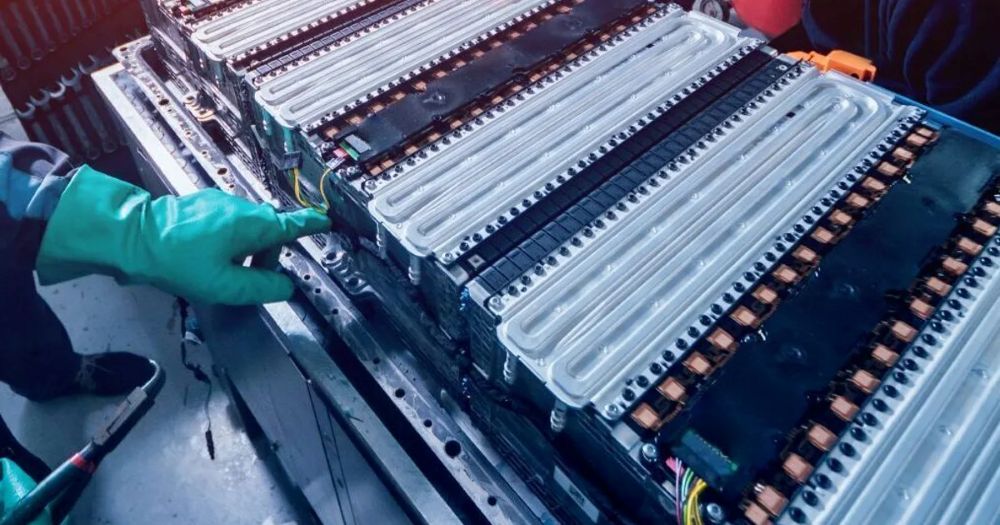
- pre-treatment (“spoke” sites), where cells are shredded into black mass, the intermediate product that carries the valuable metals;
- refining (“hub” sites), where battery-grade lithium, cobalt and nickel compounds are recovered from black mass, typically by hydrometallurgy.
According to the study, material value only stays in Europe if refining capacity is built here too; pre-treatment alone is not enough. This matches what we covered in our analysis of the Transport & Environment briefing: at least two thirds of the black mass generated in the EU leaves the Union, mostly for South Korea and Southeast Asia. Working industrial examples of closed-loop recovery already exist: Tesla reports recovering more than 90 per cent of key battery materials in its US operations.
A key turning point comes in November 2026, when waste lithium-ion batteries and black mass will be classified as hazardous waste (EU 2025/935), prohibiting their export to non-OECD countries. The authors expect this to support the build-out of European recycling capacity.
Building that capacity is not automatic, however. Drawing on a WWF Germany map, the study points out that several announced European battery recycling projects have already been cancelled – because of high investment needs, uncertain feedstock supply and difficulty winning local acceptance. We covered the economics in detail in connection with a Leipzig study: the technology works, but the business model does not yet.
Who the actors are, and what they need
The study also names a conflict of interest within the industry. Shredders and black mass producers currently benefit from the export model. Hydrometallurgical recyclers, by contrast, need investment support and predictable feedstock: clear information on incoming battery volumes, chemistries and material composition – which the digital battery passport could partly provide – and assurance that automotive and battery manufacturers will actually buy the recovered material.
On the manufacturers’ side, resistance to stricter recycling requirements is likely because of administrative burden and financing needs. Extended producer responsibility (EPR) schemes, however, already require producers to account for future recycling obligations, making more efficient recycling a financial question for them too.
The EU timeline: where are the entry points?
The study sets out the legislative entry points in detail. For recycling, the most important are:
- Batteries Regulation (2023/1542): Article 8 sets mandatory recycled content – for lithium 6% (2031) and 12% (2036), cobalt 16% and 26%, nickel 6% and 15%. The targets will be reassessed in 2028 in light of raw material availability; the authors argue that the current ambitious levels should be preserved.
- The Batteries Regulation review due by mid-2031: the study recommends adding manganese and graphite, and counting as recycled content only material from closed-loop processes – battery production scrap and end-of-life lithium-ion batteries. This would prevent secondary materials from other sectors simply being reallocated to the battery industry.
- Critical Raw Materials Act (CRMA): by 2030, EU recycling capacity should be able to supply at least 25 per cent of annual consumption of strategic raw materials. Delegated acts setting recycling capacity benchmarks for waste streams are due by 1 January 2027, and the critical raw materials list will be reviewed by May 2027. Member States’ national programmes under Article 26 are, according to the study, already overdue.
- Circular Economy Act: the Commission is due to present the draft at the end of 2026, with adoption expected in 2027. Its aim is to create an EU market for secondary raw materials.
- Other related instruments: the RESourceEU Action Plan and its Battery Booster, public procurement under the Industrial Accelerator Act, the ELV Regulation that entered into force in August 2026 (addressing “missing” vehicles), and the Ecodesign for Sustainable Products Regulation (ESPR), whose 2030 review will decide whether vehicles stay excluded.
The other four levers: smaller cars, more efficient drives, less driving
According to the study, recycling is only one side of the equation; moderating demand matters just as much.
Downsizing. In ambitious scenarios, smaller cars could reduce demand for key battery materials by roughly 17 per cent by 2035, and by 2045 by 18 per cent for lithium, 19 for nickel and 21 for cobalt. The EU’s Automotive Omnibus proposes a new M1E category for small, affordable electric cars with a maximum length of 4.2 metres; the authors would tighten this to 4.0 metres. They cite Japan’s kei cars, which made up almost 40 per cent of the Japanese vehicle fleet in 2016. The risk they flag is a rebound effect: if a small car supplements rather than replaces a larger one, household fleets grow.
Energy efficiency. A more efficient car needs a smaller battery for the same range. Estimates put the savings at around 14 per cent by 2035 and 25–29 per cent cumulatively to 2050. There is currently no legal incentive in the EU for the energy efficiency of electric cars – whereas China has had a mandatory consumption standard since January 2026. The authors would build a minimum energy-efficiency threshold into the CO₂ fleet standards and A–G energy classes into the car labelling directive.
Modal shift and travel avoidance. Shifting to public transport, cycling and walking, and avoiding unnecessary trips, could reduce lithium, nickel and cobalt demand by 10 per cent by 2035 and around 36 per cent by 2050 (this estimate also includes light commercial and heavy-duty vehicles). Most of these decisions sit with Member States and local authorities; the EU’s role is mainly indirect, through the 2028–2034 Multiannual Financial Framework, the obligation for Sustainable Urban Mobility Plans (SUMPs) under the TEN-T Regulation, and the ETS2 and Social Climate Fund launching in 2028.
The Hungarian reading: what it means locally
The study does not mention Hungary, but given the country’s industrial structure several of its findings apply directly.
The first concerns feedstock. In Europe, the volume of end-of-life EV batteries is still small; most black mass comes from production scrap. With several large cell plants operating in Hungary, domestic production scrap is a feedstock base that matters on a European scale. The study’s proposal – that only closed-loop material should count as recycled content – would raise the value of exactly this stream.
The second concerns value added. If Hungary builds mainly pre-treatment (shredding) capacity but no refining, then by the study’s logic the value of the recovered metals is realised elsewhere. The hazardous waste classification from November 2026 and the export restrictions expected in the Circular Economy Act could shift that balance.
The third concerns public acceptance. The study names local opposition as one reason for project cancellations, and Hungary knows this well: the battery processing plant Andrada planned for Alsózsolca, near Miskolc, was abandoned after local protests. Without transparent permitting and real environmental safeguards, even the best-intentioned recycling strategy will stall.
Methodological caveats
The study carries a strong message, but some limitations are worth keeping in mind:
- The estimates are not comparable. The percentage savings come from different sources, with different time horizons, system boundaries and baseline scenarios. The absolute tonnages were calculated by the authors using harmonised assumptions based on scenarios from the EU impact assessments for the ELV and Batteries Regulations – data that only run to 2040.
- It is a literature review, not original modelling. The prioritisation was validated in two expert interviews (IMT and T&E/Clean Cities Campaign), and the authors also used an AI tool to process the literature.
- The commissioning organisations have a stake. SOMO, Seas At Risk and PowerShift openly campaign for curbing mining, including deep-sea mining. This does not invalidate the results, but it explains the emphasis.
- The modal shift estimates are optimistic. The authors themselves note that most of the reviewed studies do not analyse how reduced car use translates into fewer new car sales.
- Cell chemistry was outside the scope. Lithium iron phosphate (LFP) batteries contain no cobalt or nickel, but their lower energy density can mean higher overall material requirements – and they carry less recoverable value, which also weakens the economics of recycling.
Conclusion
Oeko-Institut does not claim that electric mobility can work without mining – it argues that how much mining is needed is a policy choice. Battery raw material recycling is the most tangible and legally established part of that picture: the targets exist, and the question is whether they survive the 2028 and 2031 reviews, and whether Europe moves beyond producing black mass to refining it. Without smaller, more efficient cars and less driving, though, recycling can only offset part of growing demand.
FAQ: battery raw material recycling
How much can battery raw material recycling reduce demand for mining?
Significantly, according to the estimates compiled by Oeko-Institut. Around 2040–2045, primary demand in the EU could fall by 25–50% for lithium, 35–50% for nickel and 60–70% for cobalt. One source for 2040 puts the savings at roughly 36 kt of lithium, 250 kt of nickel and 51 kt of cobalt.
Does recycling reduce the total material demand of batteries?
No, it only reduces demand for primary, mined material. The total amount of material that goes into batteries stays the same, and keeps rising if cars and batteries continue to grow. That is why the study also calls for smaller, more energy-efficient vehicles, modal shift and travel avoidance to moderate demand itself.
What recycled content does the EU Batteries Regulation require?
Under Article 8 of Regulation 2023/1542, new batteries must contain 6% and later 12% recycled lithium, 16% and later 26% recycled cobalt, and 6% and later 15% recycled nickel, with deadlines in 2031 and 2036. The targets will be reviewed in 2028; the study’s authors recommend keeping the current ambitious levels.
What is the difference between pre-treatment and refining in battery recycling?
Pre-treatment shreds battery cells into black mass, an intermediate product that concentrates the valuable metals. Refining, usually by hydrometallurgy, then recovers battery-grade lithium, cobalt and nickel compounds from the black mass. According to the study, the value only stays in Europe if refining capacity is built here as well.
What other measures reduce critical raw material demand?
The study examines four further levers. Smaller cars could cut demand for key battery materials by around 17% by 2035, and energy efficiency by around 14%. Shifting to public transport and cycling and avoiding unnecessary trips could together save roughly 36% of lithium, nickel and cobalt demand by 2050.
🔗 Official sources and references: 👉
- Oeko-Institut Consult gGmbH: Decarbonising Road Transport Beyond Mining-Intensive Pathways (Research Report). Authors: Stefanie Degreif, Moritz Mottschall. Commissioned by SOMO, Seas At Risk and PowerShift. Berlin, 19 October 2026. – Study page
- Oeko-Institut press release, 19 October 2026: English version · German original
Consistent structure, quick answers: every article is built so that both readers and AI search tools can find the key points easily. Our content is produced with the help of AI tools and reviewed by our editor.
