




If you like our site, mark us as a preferred source on Google — so you’ll see our articles more often in search!
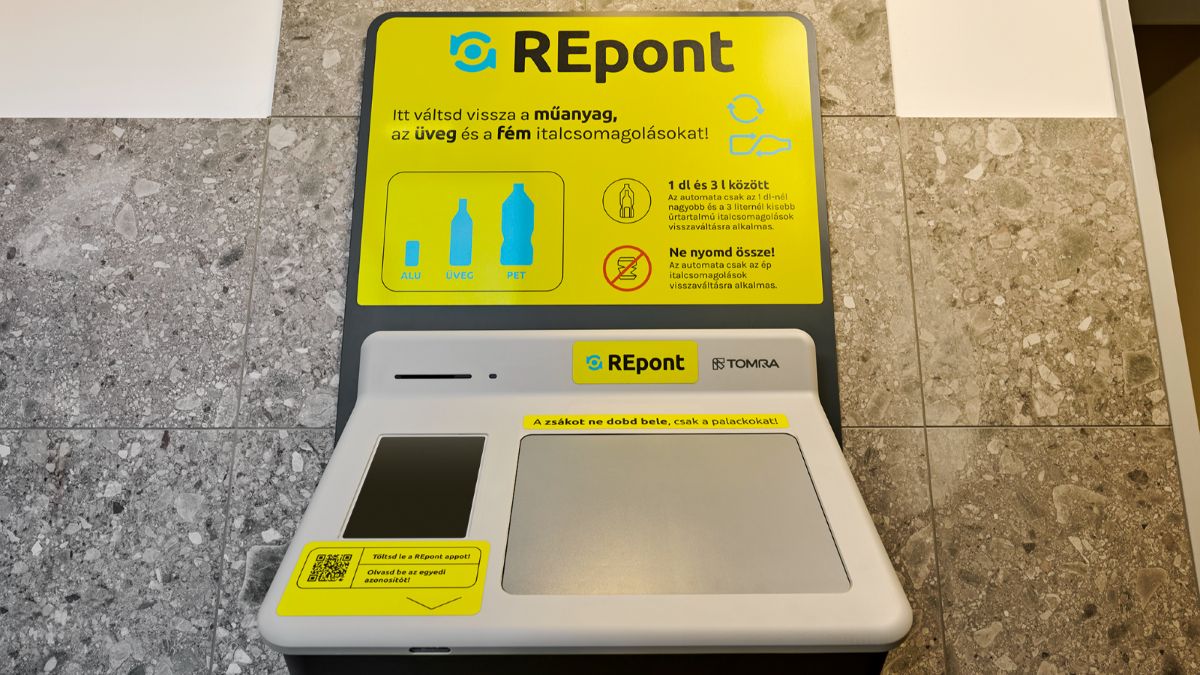
★Mark us as a preferred sourceAnyone in Hungary who has tried to feed a glass bottle carrying a deposit above 50 forints, sometimes as much as 180 or 400 forints, into a REpont reverse vending machine probably knows the result: PET bottles and cans go through without trouble, while the most valuable bottle is pushed back out. Refillable bottle returns have confused shoppers since the national deposit return system launched, and the regional news site Kemma has now put the question to MOHU, the country’s waste concession company: why do most machines refuse bottles with a deposit above 50 forints? The short answer is that the machine is not faulty. Two separate systems run side by side, and only one of them belongs to MOHU.
In short: Refillable bottle returns in Hungary are organised by producers and retailers, not by MOHU, which is why most REpont machines do not accept these bottles. They can usually be returned only in shops that sell the product, either over the counter or through a special machine that handles bottles without breaking them. A deposit above 50 forints signals that the bottle will be washed and refilled rather than crushed.
What MOHU told Kemma
The Kemma reporter started from personal experience: bottles worth 180 or even 400 forints were refused at REpont machines in several shops, including the one where the product had been bought. The bottles ended up either in the collection bin next to the machine or back at home. The paper then asked the concession company for an explanation.
According to MOHU, the cause is typically not technical. Bottles with a deposit above 50 forints are mostly refillable beverage containers, and handling them is fundamentally outside the company’s remit. Under the legislation, the conditions and locations for returning them are set by producers and distributors, who are also responsible for informing consumers in full.
MOHU added that it collects more than 3 billion single-use beverage containers a year, around 90 percent of the volume placed on the market. That matches the half-year figures we analysed earlier: Hungary’s deposit return system in the first half of 2026 had already reached 1.5 billion containers, with a 12-month return rate of 90.1 percent.
Waste or product? That is the dividing line
From a waste management point of view, the difference between the two systems is conceptual rather than technical. A single-use bottle becomes waste once it is empty: MOHU collects it as waste, the machine compacts or breaks it, and the material becomes feedstock again through recycling. The uniform, mandatory 50 forint deposit applies to this stream.
A refillable bottle, ideally, never becomes waste at all. It remains a piece of packaging equipment under the producer’s control that has to travel back intact to the filling plant, where it is washed and refilled. The producer therefore sets the deposit, which is why it can exceed 50 forints: replacing a bottle designed for many refill cycles costs more than the material value of a single-use container.
The division of labour follows from this. Single-use packaging is part of the concession-based waste management system, while refillables move along logistics links between producer and retailer that are often decades old: the lorry delivering beer or syrup takes the crates of empties back with it.
What a soft-drop machine can do
MOHU also told Kemma that it supports the take-back of refillable bottles with its own equipment. At certain return points, mainly those with higher traffic, REpont machines are fitted with a so-called soft-drop module, which sets the bottle down intact in a collection crate instead of breaking it.
There is an important restriction: these machines do not accept every refillable either. They take only the bottles that the given shop sells and that are covered by an agreement with the producer. This explains the common experience that the same bottle goes through in one shop’s machine and is rejected in another’s.
The number of such machines is limited as well. According to a November 2025 report by the Hungarian business site G7, roughly 400 of the several thousand machines were able to take refillable bottles. MOHU now says the locations of these machines can be found in the REpont mobile app. In our own experience this means that tapping on a given shop shows whether refillable returns are available there; the map still cannot be filtered for these sites, which G7 already criticised a year ago.
Refillable bottle returns in practice: where and how
A few simple rules follow from the above and save a wasted trip:
- Check the marking. Refillable bottles carry their own marking, different from the 50 forint deposit logo on single-use packaging. If the receipt shows a deposit above 50 forints, the bottle is almost certainly refillable.
- Take it back where you bought it, or to a shop that sells the same product. As G7 summarised, shops are obliged to take back the refillable packaging of the brands they stock themselves.
- Check the REpont app before you set off. There is no filter for sites that take refillables, but if you tap on the shop you have in mind, its details show whether this function is available there. Bear in mind that even there the machine accepts only the brands the shop sells.
- If the machine refuses it, ask for manual take-back. Many shops accept the bottle at the till or the customer service desk, as they did before the mandatory system started.
- Protect the bottle and the label. A chipped or broken bottle cannot be refilled, and the machine identifies containers by shape and barcode.
- Do not put it in the glass bank. The glass is still recycled there, but the deposit is lost and a bottle meant for many more cycles goes to the furnace instead.
- If you get stuck, ask the producer or the shop. Consumer information is their responsibility, not that of MOHU’s customer service.
A narrow segment facing rising EU expectations
Refillables are currently the smaller part of the Hungarian system. According to MOHU’s half-year report, at the end of June 2026 only 7 percent of the products registered in the deposit return system were in refillable packaging, against 93 percent in single-use packaging. The company told Kemma it has also promoted refillable packaging through communication campaigns, since refilling prevents waste from arising in the first place.
EU rules, however, are pushing the market towards reuse. The Packaging and Packaging Waste Regulation (PPWR) sets reuse targets for beverage packaging from 2030: as a general rule, final distributors must make at least 10 percent of beverages available in reusable packaging within a reuse system, with exemptions for certain product groups and the smallest shops.
So while today’s shopper experience tends to discourage people from choosing refillable glass, within a few years more of exactly this packaging is supposed to be on the shelves. The French example shows that this is a matter of organisation: Citeo’s ReUse pilot project is rebuilding a deposit system for reusables with standardised bottles, shared washing plants and a single customer journey.
What should be improved?
MOHU’s answer is legally sound: taking back refillable bottles is indeed not part of the concession. Shoppers, however, do not think in legal categories. What they see is two systems meeting at the same machine, with similar markings, in the same return corner, and only one of them working predictably.
Three changes would make a real difference:
- Clear information on the shelf and on the machine. Each shop should display which refillable bottles it takes back, and where.
- Real searchability. Today the app has to be checked shop by shop to see whether a return point takes refillables. A dedicated filter would save many wasted attempts, and since the machines accept only the brands sold in the given shop, the real help would be a search by product.
- Keeping manual take-back alive. In smaller settlements it is often the only option, yet the number of manual return points fell this year. We covered the financial background in our article on the MOHU handling fee dispute.
International experience points the same way: willingness to return ultimately depends on convenience. The environmental advantage of a refillable bottle materialises only if the bottle actually makes it back to the filling line.
Frequently asked questions: refillable bottle returns in Hungary
Why do REpont machines reject bottles with a deposit above 50 forints?
Because a bottle with a deposit above 50 forints is typically a refillable container that sits outside MOHU’s system. Most REpont machines compact or break single-use packaging, whereas a refillable bottle has to reach the producer intact. Only machines equipped for this, in shops that sell the product concerned, will therefore accept it.
Who is responsible for taking back refillable bottles in Hungary?
Producers and distributors are responsible. According to MOHU, the legislation leaves it to them to set the conditions and locations for returning refillable beverage packaging, and to inform consumers in full. MOHU’s remit covers single-use containers carrying the mandatory 50 forint deposit; it supports the collection of refillable bottles only with its equipment.
Where can refillable glass bottles be returned?
Usually in a shop that sells the product in question. Retailers take back the refillable packaging of the brands they stock, either over the counter or through a suitable machine. Tapping a shop in the REpont app shows whether refillable returns are available there, though no filter exists; if a machine refuses the bottle, ask for manual take-back.
What is the soft-drop module in REpont machines?
A soft-drop module is an add-on unit that sets the bottle down intact in a collection crate instead of breaking it. MOHU uses machines fitted with it to support refillable collection. These machines accept only bottles sold in the given shop and covered by an agreement with the producer, so the same bottle may behave differently from shop to shop.
Why is the deposit on refillable bottles higher than 50 forints?
Because the producer sets the deposit on a refillable bottle; it is not fixed uniformly by law. A refillable bottle is a sturdier, more expensive piece of packaging that is washed and refilled many times, so the producer wants it back intact. The uniform 50 forint fee applies to single-use containers, which are collected as waste and recycled.
How large is the share of refillable packaging in Hungary’s deposit return system?
It is small for now: according to MOHU’s half-year report, 7 percent of registered products were in refillable packaging at the end of June 2026, against 93 percent in single-use packaging. The EU packaging regulation, the PPWR, sets reuse targets for beverage packaging from 2030, so both a wider refillable range and simpler take-back will be needed.
🔗 Official sources and references: 👉
- Kemma.hu – Nem működik a visszaváltás? Meglepő választ adott a MOHU a drágább üvegekről (in Hungarian)
- Telex / G7 – Segítség, mit kezdjek a 80 vagy 125 forint betétdíjas üvegekkel? (in Hungarian)
- MOHU / REpont – Results of the mandatory deposit return system in the first half of 2026 (PDF, in Hungarian)
Consistent structure, quick answers: every article is built so that both readers and AI search tools can find the key points easily. Our content is produced with the help of AI tools and reviewed by our editor.
