





If you like our site, mark us as a preferred source on Google — so you’ll see our articles more often in search!
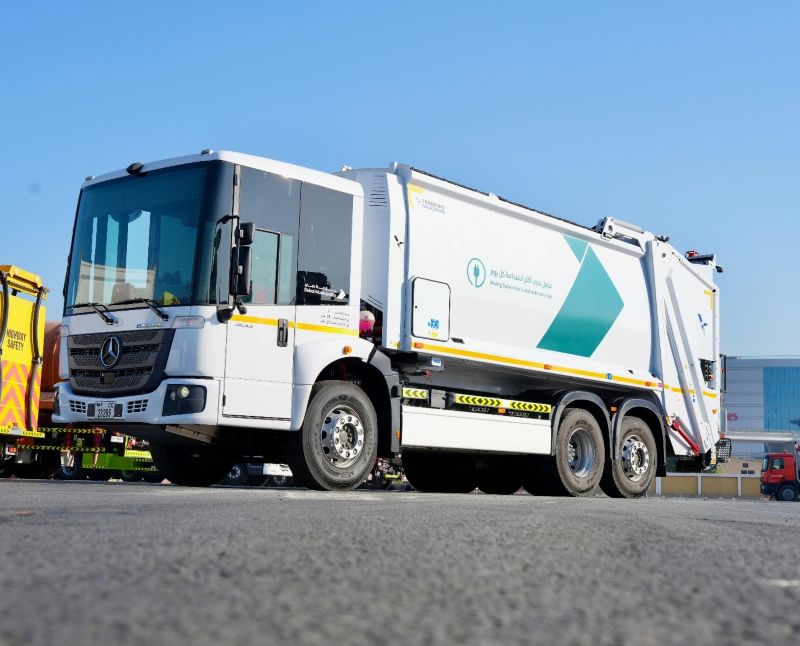
★Mark us as a preferred sourceOn 8 November 2026, Dubai Municipality put its first fully electric waste collection and transport vehicle into service. The first Dubai electric garbage truck runs on three lithium-ion batteries, covers 100–150 kilometres on a single charge, and its 19-cubic-metre body can hold up to 11 tonnes of compacted waste. But the city is doing more than adding a new vehicle: it wants to find out how heavy-duty electric trucks cope with the local climate before deciding on a wider fleet transition.
In short: The Dubai electric garbage truck is the emirate’s first waste collection vehicle powered entirely by electricity, operating 16 hours a day across two shifts. With a 160 kW charger it goes from 20 to 80 percent in 1 hour 45 minutes, and it measures the amount of waste as containers are emptied. The results of the trial will inform decisions on further fleet electrification.
What can the Dubai electric garbage truck do?
According to Dubai Municipality, the vehicle runs entirely on electrical energy stored in three high-efficiency lithium-ion batteries. Together, the batteries weigh approximately 2.2 tonnes – a clear indication of how much energy storage a heavy-duty vehicle needs to complete a full working day.
Key specifications:
- Drivetrain: fully electric, with three lithium-ion batteries (combined weight approx. 2.2 tonnes)
- Range: 100–150 kilometres per charge
- Fast charging: 20 to 80 percent in 1 hour 45 minutes using a 160 kW charger
- Body: 19 m³ total storage capacity
- Payload: up to 11 tonnes of compacted waste
- Compatible container sizes: 1.1 m³ containers, plus 360-, 240- and 120-litre bins
- Compaction: electric compactor suited to both community container emptying and door-to-door collection
- Operating schedule: two shifts, 16 hours per day in total
Container compatibility matters in practice: 120–360-litre bins are typical of single-family residential areas, while 1.1 m³ containers serve apartment blocks and community collection points. The same truck can therefore work in both collection systems – a real advantage during a trial, since it can be tested on several types of route.
Dubai Municipality also presented the vehicle’s key features in a short video on X:
#DubaiMunicipality continues to enhance city cleaning operations with the introduction of its first fully electric waste collection and transport vehicle. This innovative addition combines operational efficiency with clean technologies, contributing to improved municipal services, greater environmental sustainability and the preservation of the emirate’s urban and aesthetic appeal.
Watch the video to discover the vehicle’s key specifications.
— بلدية دبي | Dubai Municipality (@DMunicipality) November 8, 2026
Fast charging and two shifts: fitting into the daily routine
Refuse trucks are ideal candidates for electrification: they start from a fixed depot, follow predictable routes and return to base every day, where charging can be managed. As we explained in our analysis of the quiet revolution of electric garbage trucks, the constant stop-and-start cycle allows regenerative braking to recover part of the energy that a diesel truck loses as heat through its brakes.
In Dubai, the 16-hour, two-shift operation is the real test. On an urban collection round, distance is not the decisive factor: energy is consumed by frequent stops, the bin lifter and the compactor working continuously. Fast charging allows the truck to go from 20 to 80 percent during the break between shifts, so it does not have to be taken off the road overnight.
The Municipality has also trained a dedicated team – a smart vehicle technician and cleaning engineers – to operate and maintain the vehicle. This matters because an electric refuse truck is not just a vehicle but a mobile industrial machine: the same energy source powers the drivetrain, the lifter, the compactor and the on-board electronics.
On-board weighing and smart cameras
The vehicle is fitted with source-based weighing systems that measure waste as containers are emptied. Technology of this kind can also underpin pay-as-you-throw charging schemes, although Dubai Municipality’s announcement only states that the system weighs waste during emptying and says nothing about using the data for billing.
Occupational safety is supported by smart cameras that continuously monitor the different stages of the operation, as well as the vehicle’s movement and its surroundings. The system improves driver visibility, makes manoeuvring safer and reduces risks to collection crews and other road users.
Why test in the local climate?
Saeed Safar, Director of the Waste Operations Department at Dubai Municipality, described the new vehicle as a significant step in modernising the fleet. The aim of operating it is to assess how heavy electric vehicles actually perform under local climatic conditions and how well they suit Dubai’s operational requirements. The findings are intended to provide a scientific basis for potentially expanding their use across municipal operations. Safar emphasised that the goal is an integrated, sustainable waste management ecosystem that supports the transition to a circular economy, reduces reliance on conventional vehicles, improves energy efficiency and lowers emissions.
The climate question is not a formality. In summer heat, battery cooling and cab air conditioning both draw energy, which can affect range and charging times alike. This may be one reason the range is given as a band of 100 to 150 kilometres: real-world consumption depends heavily on the route, the number of stops and operating conditions.
It is also worth noting that Dubai has thereby entered the first, demonstration stage of electrification. In our earlier analysis, we noted that many cities worldwide have already moved on to fleet-scale deployment, and that where the technology is proven, single-vehicle trials are increasingly hard to justify. Dubai’s argument, however, is site-specific: extreme heat is a test that European or North American experience cannot fully answer.
A building block of the 2041 strategy
The project is part of the Dubai Integrated Waste Management Strategy 2041, which aims to reduce waste generation by 18 percent and divert 100 percent of waste from landfill by 2041. According to the announcement, the vehicle also supports climate neutrality targets, the adoption of clean energy and the preservation of the city’s urban appearance, alongside fleet modernisation.
Electrifying collection is only one element of this programme. A large share of the waste diverted from landfill goes to energy recovery: we have previously reported on the Phase 2 expansion of the Warsan Waste-to-Energy plant, which adds a further 3,000 tonnes per day and 150 MW of electrical capacity. Other emirates are following a similar path, as the Sharjah Waste-to-Energy plant’s one-million-ton milestone shows.
Lessons for European and Hungarian waste management
The most important lesson from Dubai is the method: decision-makers are not relying on a catalogue but measuring the vehicle’s performance on their own routes, in their own climate and under their own operating schedule. In Central Europe, including Hungary, harsh winter cold can pose a comparable test for batteries, so operating data collected under local conditions is the most reliable basis for any wider rollout.
Dubai electric garbage truck – frequently asked questions
What is the range of the Dubai electric garbage truck?
It can travel 100–150 kilometres on a single charge. According to Dubai Municipality, this meets the daily operational requirements of waste collection and transport services across different areas of Dubai. Giving the range as a band reflects that real-world consumption depends heavily on the route, the number of stops, the load on the lifter and compactor, and operating conditions.
How long does it take to charge the vehicle?
With a 160 kW charger, the battery goes from 20 to 80 percent in 1 hour 45 minutes. Fast charging matters because the truck operates across two shifts totalling 16 hours a day, so it can take on substantial energy during the break between shifts rather than being taken off the road overnight.
How much waste can it carry at once?
Up to 11 tonnes of compacted waste. The body has a total storage capacity of 19 cubic metres, and the built-in electric compactor compresses the collected waste. The truck’s three lithium-ion batteries weigh around 2.2 tonnes combined, showing how much energy storage a heavy-duty waste collection vehicle needs for a full working day.
Which waste containers can it empty?
It handles four standard container sizes: 1.1 cubic metre containers and 360-, 240- and 120-litre bins. This means it can be used both at community collection points and for door-to-door collection. During emptying, source-based weighing systems measure the amount of waste, while smart cameras monitor the operation and the vehicle’s surroundings.
Why is Dubai testing an electric garbage truck?
To find out how heavy electric vehicles actually perform under local climatic conditions. According to Saeed Safar, Director of the Waste Operations Department at Dubai Municipality, the findings will provide a scientific basis for potentially expanding the use of electric vehicles across the city’s waste collection and transport operations in the future.
How does the project relate to Dubai’s 2041 strategy?
The vehicle supports the goals of the Dubai Integrated Waste Management Strategy 2041. The strategy aims to reduce waste generation by 18 percent and divert 100 percent of waste from landfill by 2041. Alongside fleet modernisation, large-scale energy recovery capacity, such as the Warsan Waste-to-Energy plant, also contributes to these targets.
🔗 Official sources and references: 👉
- Dubai Municipality: First fully electric waste collection vehicle (8 November 2026)
- Dubai Municipality (@DMunicipality) on X: video of the vehicle’s key specifications (8 November 2026)
Consistent structure, quick answers: every article is built so that both readers and AI search tools can find the key points easily. Our content is produced with the help of AI tools and reviewed by our editor.
