



If you like our site, mark us as a preferred source on Google — so you’ll see our articles more often in search!
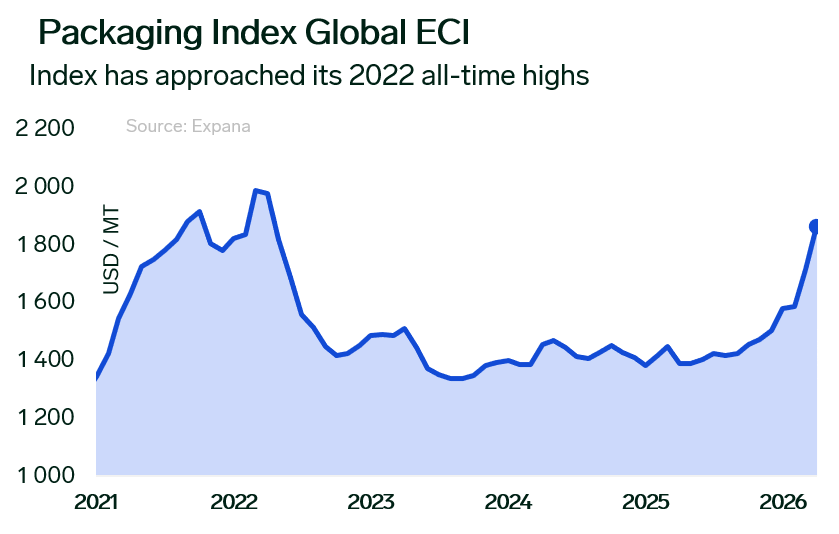
★Mark us as a preferred sourceThe significant price increases experienced in the packaging materials market in April 2026 are primarily driven by global processes outside the sector. The latest market analysis by Expana (formerly Mintec) highlights that the appreciation of raw materials is fueled by energy market trends and escalating geopolitical conflicts, especially the events in the Middle East. Although supply chains are under severe pressure, domestic demand alone would not justify the current price explosion.
Aluminum Market: The Middle East Conflict and Supply Collapse
One of the primary economic victims of military activities in the Middle East has been the aluminum supply. The collapse of shipments from the region has resulted in a severe market deficit since early March. Because the price of primary aluminum is directly built into the prices of packaging materials, the market immediately reacted to the shortage, which was felt across both the American and European continents. Based on quantified data, month-over-month (MOM) price increases developed as follows:
-
In the United States, the price of aluminum foil increased by 2.9%, while aluminum cans rose by 4.4%.
-
In Europe, aluminum foil grew by 2.7%, and the price of aluminum cans increased by 2.6%.

Plastic Packaging Materials: Drastic European Price Surge Due to the Closure of the Strait of Hormuz
In the plastic packaging materials segment, much sharper regional differences emerged between the two continents. Europe experienced a literal price shock:
-
The price of polypropylene (PP) jumped by an outstanding 43.4% compared to the previous month.
-
High-density polyethylene (HDPE) became 39.2% more expensive.
-
The price of polyethylene terephthalate (PET) rose by 33.7% in the span of a single month.
In contrast, growth in the United States market was more moderate, though still significant: depending on the type of plastic, a 6-7% price increase was registered on a monthly basis. The massive price gap between Europe and America clearly reflects the vulnerability of the European plastics industry. European production relies significantly more on naphtha and ethylene arriving through the Strait of Hormuz. Consequently, the de facto closure of the strait due to the Middle East conflict triggered an immediate, drastic price increase for these key hydrocarbons in the European market.
Paper Industry: Accumulating Pulp Prices and Panic Buying
Remarkable price increases can also be observed in the paper-based packaging market. In Europe, the main driving force has been the continuously accumulating pulp prices since early 2026, which were compounded in April by a drastic 15-30% rise in waste paper prices, depending on quality. Fearing further price hikes, consumers ramped up their purchases. Taking advantage of this increased demand, suppliers in Europe quickly raised their prices by 3-5% (MOM), depending on quality. In the US market, suppliers also implemented price increases recently after a prolonged pause:
-
The price of linerboard rose by 4.6% on a monthly basis.
-
Testliner (recycled paper-based linerboard) became 5.4% more expensive.
Conclusion: Domestic Demand is Not the Driver
Artem Segen’s analysis confirms that the current price dynamics are clearly driven by global raw material and energy prices, rather than the organic growth of internal demand for packaging materials. Macroeconomic and geopolitical factors have left supply chains highly vulnerable, and every segment of the market is being forced to price in the consequences.
Reference: The original content underlying this analysis is research by Expana (formerly Mintec before its rebranding): Packaging Materials Prices Rise Due to External Factors.


