


If you like our site, mark us as a preferred source on Google — so you’ll see our articles more often in search!
★Mark us as a preferred sourceThe growing performance demands of industrial sectors—including construction, automotive, and aerospace—coupled with climate change, are increasingly directing experts’ attention toward sustainable materials with a low environmental footprint. A recent study, published in the Journal of Natural Fibers, investigates the structural application of agricultural waste derived from the pruning of the prickly pear cactus (Opuntia ficus-indica). The study highlights that the three-dimensional fibrous network extracted from the plant could serve as an excellent, eco-friendly alternative to traditional synthetic reinforcing fibers, paving the way for greener and more sustainable building materials.
From Synthetic Composites to Natural Fibers: Why the Cactus?
In modern industry, including civil and architectural applications, carbon, glass, and aramid fiber-reinforced polymer composites (FRCs) are widely used due to their excellent strength-to-weight ratios. However, based on research data, the production of synthetic carbon fibers can require up to 14 times more energy than traditional steel, and the carbon dioxide equivalent (CO2e) during the lifecycle of carbon fibers (CF) ranges between 12.2 and 55.8 kg/kg. An additional disadvantage of such high-performance composites using thermosetting resins is their non-recyclability, as they suffer thermal degradation when heated.
Although traditional plant-based alternatives, such as flax and hemp, are more sustainable, they require agricultural land. A life cycle assessment (LCA) focusing on flax cultivation pointed out that synthetic fertilizers are responsible for 70–90% of environmental impacts, and their excessive use causes nitrous oxides to enter the atmosphere and chemicals to leach into water bases. While hemp cultivation does not require pesticides and can extract heavy metals from the soil, its land use demand is constantly growing: in the EU in 2022, the area dedicated to hemp cultivation reached 33,020 hectares (a 60% increase compared to 2015), and in the Netherlands, the land area used grew by 74% in a single year.
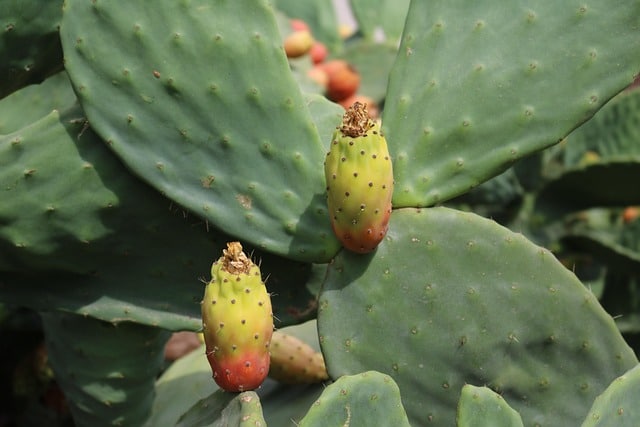
In contrast, the Opuntia ficus-indica (OFI), or prickly pear cactus, is a fast-growing plant in arid and semi-arid climates. The waste from its simple pruning (known as “cladodes”) offers lignocellulosic-based reinforcing fibers without the need to destroy the plant itself or take away extra agricultural land.
The Mechanical Role of the Hierarchical Three-Dimensional Fibrous Network
One of the main findings of the study is that cactus leaves should not be ground into powder—as previous research has often done—because this destroys the unique, hierarchical structure of the fibrous network. The network fibers of the cactus have biologically evolved to provide optimal mechanical resistance against bending stresses. By retaining this in-plane 3D structure, the network itself can provide excellent structural reinforcement in biocomposites. According to researchers, this property makes it suitable for creating architectural and civil elements that can inherently withstand low-velocity impacts and bending loads, making the special and costly directional alignment of individual fibers unnecessary.
Comparison of Two Different Extraction Methods
During the research, fibers were extracted from young (under 3 years old) and old (over 3 years old, already woody, i.e., partially lignified) cactus leaves using two different methods: Water Retting (WR) and Solid-Liquid Extraction (SLE).
-
Water Retting (WR): This is an ancient method based on biological degradation, during which 5 old and 5 young cactus leaves were immersed in approximately 10 liters of water at room temperature (18–23 °C). Exactly 25 days were required to achieve degradation and the complete separation of non-fibrous parts. The disadvantage of the method is the significant time requirement, the odors associated with decomposition, and the resulting wastewater, but the result is a fiber of outstanding quality. Drying was carried out in an artificial air flow oven at 45 °C and 70 °C; at 70 °C, the networks of old cactus leaves dried completely in just 8 hours, while at the lower (45 °C) temperature, it took 20 hours.
-
Solid-Liquid Extraction (SLE): During this technology, a 40-liter Naviglio extractor was used at a circuit pressure of 810.6 kPa, and the cactus leaves were placed in 25 liters (then an additional 20 liters) of tap water. The greatest potential advantage of the method is that it can reduce processing time by up to 90%. During the tests, 24 and 72-hour processes were tried. However, it was found that even the 72-hour extraction was not sufficient for the perfect removal of non-fibrous parenchyma tissues, which hindered subsequent processing.
Quantitative Results and Material Testing Metrics
Researchers deployed six different analytical procedures for quality control, including a scanning electron microscope (SEM – Hitachi SU3900), Fourier-transform infrared spectroscopy (FT-IR – Bruker INVENIO S), X-ray diffraction (XRD – STOE STADI P), and thermogravimetric analysis (TGA). The most important quantitative results highlighted sharp differences between the two methods:
-
Crystallinity Index (CI): According to XRD measurements, the cellulose crystallinity of samples prepared with the water retting (WR) procedure was extremely high, showing values between 39–69%. For the SLE samples, this indicator was only 13–53%. Higher crystallinity and cellulose content directly indicate better mechanical properties, thereby WR fibers result in more stable building materials.
-
Chemical and Thermal Stability: TGA and FT-IR tests proved that fibers produced with WR technology have a much higher cellulose and hemicellulose content. According to the analyses, the thermal degradation of these lignocellulosic fibers begins around 200 °C. This is particularly critical for manufacturing, as the melting point of thermoplastic matrices frequently used in the construction industry, such as polypropylene (PP), is 165 °C, and its typical processing range is 180–230 °C, meaning the materials’ exposure hovers at the limit of degradation.
-
The Risks of Non-Fibrous Material (Parenchyma): The cell tissue (parenchyma) left behind during the accelerated SLE procedure proved to be extremely harmful. It increases the water-binding capacity (hydrophilic nature) of the network, which reduces moisture resistance, and furthermore, it inhibits the proper adhesion of the fibers and the polymer matrix during composite manufacturing.
Summary and Future Prospects
Based on the results, it is clear that the age of the cactus and the extraction process drastically affect its usability as a building material. The study concludes that fibrous networks extracted from older (more than 3 years old) cactus leaves possess the most ideal parameters for use in biocomposites.
Although solid-liquid extraction (SLE) is attractive from an industrial standpoint due to up to 90% time savings, the residual non-fibrous tissues currently degrade the quality too much (in the future, increasing the 72-hour duration to possibly 6 days might offer a solution). Currently, the slower, 25-day water retting (WR) provides the outstanding crystallinity and tissue purity that is a prerequisite for load-bearing composite materials and, consequently, innovative, green architectural elements.
The original, full research material and detailed methodology on which this article is based are available at the following link on the Taylor & Francis Online platform: Citation: Extraction and Characterization of Opuntia ficus-indica Fibrous Networks from Agricultural Waste for Sustainable Biocomposites (Journal of Natural Fibers, 2026)


