





If you like our site, mark us as a preferred source on Google — so you’ll see our articles more often in search!
★Mark us as a preferred sourceOn paper, circular construction in Austria looks good: almost four-fifths of demolition waste is recovered. But the “kreislaufwirtschaft:bauen” potential study, prepared by TU Wien (Vienna University of Technology) on behalf of STRABAG and presented in September 2026, shows what lies behind the headline numbers: a great deal of downcycling, excavated soil sent to landfill, and re-use opportunities that are barely tapped. We looked at what the 152-page study and its executive summary actually say – and which parts deserve a critical reading.
In short: Circular construction in Austria today rests mainly on recycling volumes, while genuine, value-retaining circularity is still in its infancy. According to the study, the largest untapped reserves lie in excavated soil and in the re-use of building components. Unlocking them will take changes in regulation, standards and mindset.
Why construction?
Austria aims to be climate-neutral by 2040, and its 2022 national circular economy strategy targets an 18 percent share of recycled or re-used materials in total material consumption by 2030. Construction is unavoidable here: according to the study, around 60 percent of Austria’s total material consumption is linked to the construction sector – 88 percent for steel, 60 percent for copper and 39 percent for aluminium.
The stakes can also be measured in money. The study cites a 2025 report commissioned by the Austrian Ministry of Finance, which estimates that missing the climate targets could cost up to EUR 5.9 billion in emission compensation payments by 2030. The authors’ argument is simple: part of the public money spent on supporting circular construction could be recovered through avoided penalties – although they themselves consider the exact size of this effect a subject for further research.
77 million tonnes a year: Austria’s “built backpack”
One of the study’s most striking findings is its material balance. Austria builds a lot and demolishes little: on average, eight times more building material goes in than comes out as waste. Between 2010 and 2024, annual building material use rose from 58 to 88 million tonnes, an increase of 51 percent; within this, the use of gravel and sand doubled and steel use nearly tripled.
The result is that the material stock held in buildings and infrastructure grows by around 77 million tonnes every year. Per person, this amounts to 400–500 tonnes of built-in material – roughly the weight of an Airbus A380 – growing by about 8.4 tonnes per person each year. Economically, this “backpack” is good news today because it sustains jobs, but in 30, 50 or 70 years all of it will have to be demolished and managed. On top of that, the material composition of today’s buildings is becoming more complex, so tomorrow’s demolition waste will be harder to process.
Plenty of recycling, little real circularity
Construction and demolition waste (excluding excavated soil) amounted to 11 million tonnes in 2024. Of this, 8.6 million tonnes (78 percent) was recovered as material, and only 1 million tonnes (9 percent) went to landfill. Concrete and asphalt reach recovery rates of around 95 percent, masonry 68–70 percent.
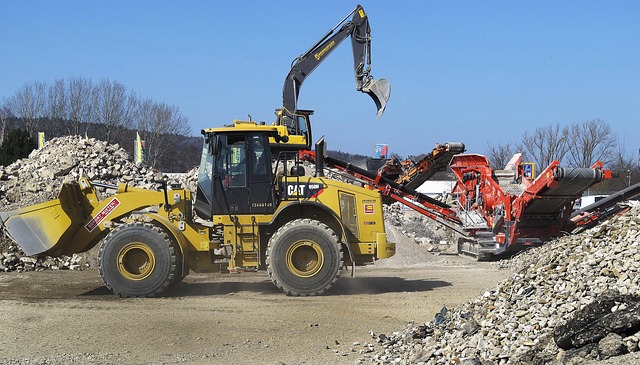
The study warns, however, that much of this recovery is in fact downcycling – use in lower-value applications. Crushed concrete mostly ends up as a road base layer rather than new concrete. Austria’s 1,157 registered stationary and mobile processing units handled roughly 13 million tonnes of demolition waste and soil in 2024, yet only about 65 percent of their output reached U-A, the top quality class under the Austrian Recycled Building Materials Ordinance, which can be used without restrictions. The rest typically goes to backfilling, landscaping or other lower-grade uses.
Improving quality is technically possible for many materials but comes at a cost. The study therefore calls for targeted public funding for research into, and industrial roll-out of, high-quality recycling.
The giant underground: excavated soil
The biggest item is not demolition rubble but excavated soil. According to the study, soil dug up on construction sites accounts for around 57 percent of Austria’s total waste. In 2024, 38 million tonnes were generated, of which only 8.1 million tonnes (21 percent) were recovered, 22.6 million tonnes (almost 60 percent) went to landfill, and the remaining 19 percent or so cannot be assigned statistically (for example, material stored temporarily and recovered the following year).
Technically, up to 90 percent of it could be recovered. In practice, even the recovered share is almost entirely downcycled: around 80 percent is used as backfill, 10–15 percent in land reclamation, and at most 8 percent in high-value applications such as concrete mixing plants or brickworks.
The reasons are complex. Soil is legally classified as waste from the outset, landfilling is often cheaper than recovery, transport costs are high on remote sites, and processing geologically heterogeneous soil is expensive. Meanwhile, pressure on landfills is rising: the number of soil landfills has doubled to 949 in twenty years, and mountainous or densely built-up provinces such as Vorarlberg are already expecting capacity shortages. Residents also tend to oppose new landfill sites. Regulation is tightening too: since January 2024 certain recoverable mineral construction wastes, and since January 2026 plasterboard, may no longer be landfilled.
Re-use: from salvaged doors to steel beams
The re-use of building components is not even measured statistically in Austria and is applied only sporadically. Based on expert interviews and international examples, the study nevertheless sees significant potential. In a Swiss pilot project, re-used steel beams avoided 91 percent of the beams’ greenhouse gas emissions. According to the authors, the biggest impact lies in re-using load-bearing structures, because that is where the largest masses are.
The study highlights a set of “low-hanging fruit” categories that can already be re-used economically today:
- Fire doors: worthwhile from just three units, and the test certificate is transferable.
- Steel beams and profiles: profitable from 3–6 units for standard cross-sections, already common practice in steel construction.
- Light fittings: low testing requirements, and they can be converted to LED.
- Oak strip parquet: 1.2 million square metres are available in Vienna alone, saving 54 kilograms of CO₂ per square metre.
- Serial elements: when Vienna’s Ferry-Dusika stadium was dismantled, 5,500 grandstand seats were passed on for re-use.
- Aluminium façade panels: worth around EUR 500 per square metre as a product, but only EUR 50 as scrap.
Overall, according to the study, reclaimed materials cause around 90 percent less CO₂ and are roughly 20 percent cheaper than new products. In practice, however, this advantage is often eaten up by non-standardised recertification, complicated procurement and transport logistics, and the lack of a central register. The experts see the key in manufacturers becoming “salvage centres” for their own products – the study cites robot-assisted plasterboard dismantling with return to the manufacturer as one example.
Does circular construction pay off?
One of the most eye-catching charts in the executive summary suggests that the full life-cycle cost of circularity-optimised buildings can be lower than that of conventional ones: EUR 686 instead of 908 per square metre for a school, 1,294 instead of 1,662 for a detached house, and 1,241 instead of 1,817 for an office building. The difference arises because the calculation includes demolition and credits for re-usable components.
It is worth knowing, however, that these figures come from three fictional examples in a 2021 German reference book. TU Wien’s own BIM-based calculations paint a more nuanced picture: in the circularity-optimised variants, construction costs were on average 16.6 percent higher and 50-year life-cycle costs 6.6 percent higher, while the carbon footprint fell by around 80 percent and waste mass by a third. The authors sum it up themselves: clearly positive ecologically, economically positive only at life-cycle level. Given the lack of data on demolition costs and diverging calculation methods, they call for a unified methodology and more transparent data.
Nine recommendations for policy and industry
The study sets out nine concrete recommendations:
- Practical quality criteria for secondary building materials, because the current, insufficiently differentiated requirements push even clean and safe material out of the loop too early.
- New recycling technologies for increasingly complex demolition waste, combined with careful selective dismantling from the outset.
- Regulatory room for excavated soil: the degree of contamination, technical suitability and intended use should decide, with a uniform European rule in the long term.
- A mandatory building resource passport for new buildings, major renovations and public buildings, documenting the materials used, their origin, pollutant content and ease of dismantling – compatible with the EU Digital Product Passport.
- Uniform, practical recertification for re-used components (load-bearing capacity, fire safety, absence of pollutants, durability).
- A mandatory “re-use check” before demolition, modelled on Germany’s DIN SPEC 91484, since Austria’s ÖNORM B 3151 covers recycling only, not re-use.
- Measurable circularity requirements in public procurement, with material-specific, realistic minimum quotas – we covered the EU dimension of this debate in our article on green public procurement.
- Targeted public funding not only for research but also for pilot plants, demonstration projects and first industrial-scale deployment.
- A shift in building culture, because secondary materials are still often dismissed as “inferior” by default.
What deserves a critical reading
The study is thorough and rich in data, but a few points call for caution. First, the commissioning party is Austria’s largest construction company, which has a direct interest in subsidies and in how regulation is shaped. This does not undermine the results – the methodological work was done by university researchers – but it should be kept in mind when reading the emphasis.
Second, some claims in the executive summary are simpler than in the full study. The life-cycle cost chart is based on fictional literature examples, while the study’s own calculations show higher costs. The per-capita material stock also appears with different figures: 360 tonnes in the illustration, 400–500 tonnes in the text.
Third, the documents are not consistent on public procurement quotas. The summary calls for “clear quotas instead of voluntary approaches”, while experts quoted in the full study warn of a “quota paradox”: a blanket re-use quota of, say, 30 percent could lead to buildings being demolished simply to harvest re-usable material – which is why they favour targeted incentives. The answer probably lies in material-specific, realistic quotas, but this debate deserves an open mind.
Finally, a key principle the study itself stresses: the most sustainable building is the one that is not demolished. A house used for a hundred years beats one demolished after twenty years and perfectly recycled. Three-quarters of Austria’s buildings were built before 1990, and the authors see this slow turnover as a genuine advantage.
Lessons for Hungary and the wider region
Much of this will sound familiar to Hungarian readers. Behind high recovery rates, backfilling and landscaping often dominate in Hungary too, excavated soil typically starts life as waste here as well, and there is no central register of salvaged, re-usable building components either. The Austrian example shows that real circularity in construction depends less on meeting recovery quotas and more on the quality of material coming out of demolition – and on whether there is a market for it.
Several of the Austrian proposals would translate easily: a re-use survey before demolition, documentation of building materials, regulatory flexibility for recovering excavated soil, and public procurement as a demand driver. Construction is one of the largest yet most overlooked areas of waste management – you can find more of our coverage under the circular economy tag.
Circular construction – frequently asked questions
What does circular construction mean?
Circular construction is an approach to building that keeps materials in use for as long as possible. It covers extending building lifetimes, re-using salvaged components and high-quality recycling. According to the STRABAG and TU Wien study, Austria today mainly achieves recycling by volume, while genuine, value-retaining circularity is still at an early stage.
How much construction and demolition waste does Austria recover?
In 2024, Austria recovered 78 percent, or 8.6 million tonnes, of its 11 million tonnes of construction and demolition waste, excluding excavated soil. According to the study, however, much of this is downcycling, such as crushed concrete used as road base. Only about 65 percent of processing plant output reached the unrestricted U-A quality class.
Why is excavated soil the biggest problem?
Because excavated soil makes up around 57 percent of Austria’s total waste, yet only 21 percent of it is recovered. In 2024, 22.6 million of 38 million tonnes went to landfill, even though up to 90 percent could technically be recovered. The main obstacles are its legal classification as waste, cheap landfilling, transport costs and the soil’s heterogeneity.
Which salvaged building components are worth re-using today?
According to the study, fire doors from three units, standard steel beams from 3–6 units, light fittings, oak strip parquet, serial elements such as stadium seats, and aluminium façade panels can already be re-used economically. Reclaimed materials cause around 90 percent less CO₂ and are roughly 20 percent cheaper than new products.
Is circular building cheaper than conventional construction?
Not at the time of construction, as a rule. TU Wien’s own calculations show that circularity-optimised buildings cost on average 16.6 percent more to build and 6.6 percent more over a 50-year life cycle, while their carbon footprint is around 80 percent lower. The lower life-cycle costs shown in the executive summary are based on fictional literature examples that include demolition credits.
What is a building resource passport?
A building resource passport is a digital record of which materials and products, in what quantities, have been built into a building. It also covers their origin, pollutant content, connection types and ease of dismantling. The study proposes making it mandatory for new buildings, major renovations and public buildings, compatible with the EU Digital Product Passport.
🔗 Official sources and references: 👉
- STRABAG – “kreislaufwirtschaft:bauen” potential study page: work-on-progress.strabag.com/de/potenzialstudie
- Executive summary (PDF, German): Executive Summary kreislaufwirtschaft:bauen
- Full study (PDF, German, TU Wien): Potenzialstudie kreislaufwirtschaft:bauen
- Detailed chapters: Recycling and downcycling · Re-use · Profitability
Consistent structure, quick answers: every article is built so that both readers and AI search tools can find the key points easily. Our content is produced with the help of AI tools and reviewed by our editor.
