




If you like our site, mark us as a preferred source on Google — so you’ll see our articles more often in search!
★Mark us as a preferred sourceBy integrating Hydro Circal, both Mercedes-Benz and General Motors are making significant strides to reduce the carbon footprint of the automotive industry and strengthen the circular economy. Based on recent announcements from Norsk Hydro, recycled and low-carbon aluminium is playing an increasingly crucial role in the serial production of next-generation electric vehicles (EVs), reshaping global and regional supply chains.
Mercedes-Benz and the European Expansion of Hydro Circal
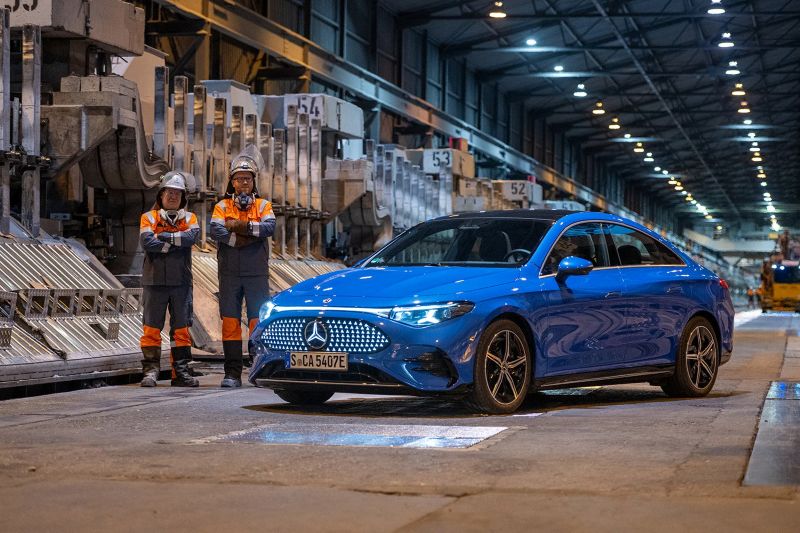
Mercedes-Benz will become the first automotive company in Europe to integrate the Hydro Circal alloy into series production for its next generation of large electric vehicles. This recycled aluminium is manufactured using at least 75 percent post-consumer scrap, a substantial increase from today’s industry minimum of 25 percent. The material is produced through advanced recycling operations that recover aluminium from end-of-life vehicles, buildings, and infrastructure, directly returning it to new automotive applications.
Eivind Kallevik, President and CEO of Hydro, emphasized: “The automotive industry needs materials that can cut emissions without compromising quality, safety or performance. By combining Hydro CIRCAL recycled aluminium with Hydro REDUXA low-carbon primary aluminium, we can accelerate the transition to lower-carbon vehicles.”
The two companies signed a letter of intent (LoI) in December 2022 for a technology roadmap between 2023 and 2030, and in 2024, they extended their collaboration to cover the entire aluminium value chain. Mercedes-Benz already sources Hydro REDUXA, which is made using electrolysis powered by renewable energy and boasts a carbon footprint more than 70 percent lower than the global average. As a joint initiative, they also launched the Corridor Program in Brazil, combining decarbonization with social responsibility. According to Yanni von Roy-Jiang, Head of Procurement at Mercedes-Benz AG, the next generation of supply chains will be defined by deeper localization and higher circularity.
General Motors and the Cadillac OPTIQ: Innovation in the U.S. Market
In North America, General Motors’ 2026 Cadillac OPTIQ model showcases the innovative use of this material. The vehicle will feature a front bumper system made from this same alloy containing at least 75 percent post-consumer scrap. The raw material is produced at Hydro’s newest U.S. recycling facility in Cassopolis, Michigan. The engineering and assembly of the bumper system are handled by automotive supplier Shape Corp. to GM specifications.
The front bumper beam is a critical, structural crash-management component located behind the visible bumper cover. Its function is to absorb and distribute impact energy during collisions, protecting passengers, pedestrians, and vital EV systems. Duncan Pitchford, Vice President of Recycling at Hydro Aluminum Metal, stated that bringing recycled aluminium back into such demanding vehicle applications reduces embedded emissions and strengthens material circularity.
Transparency, Verification, and Emission Reductions
The recycled product line offers outstanding environmental metrics. The profiles supplied for GM yield a market-leading carbon footprint of 1.5 kg CO₂e per kg of aluminium (or lower), which represents an estimated 70 percent reduction in CO₂ emissions compared to the North American average for primary aluminium production. This is achieved while meeting strict automotive requirements for strength, energy absorption, and corrosion resistance.
The minimum 75 percent post-consumer scrap content is verified by an independent third party, DNV. Each batch carries verified documentation, ensuring complete transparency throughout the supply chain. Through localized manufacturing, both GM and Mercedes-Benz are creating shorter, more efficient, and highly resilient regional supply networks.
FAQ
What is Hydro Circal?
Hydro Circal is a recycled aluminium product line containing a minimum of 75 percent post-consumer scrap, which is verified by an independent third party (DNV).
Which automotive brands use this material?
Mercedes-Benz is integrating it into its next generation of European electric vehicles, while General Motors uses it for the front bumper system of the 2026 Cadillac OPTIQ.
What is the carbon footprint of the product?
For North American applications, the material offers a carbon footprint of 1.5 kg CO₂e per kg of aluminium, which is an estimated 70 percent reduction compared to the regional average. Hydro REDUXA primary aluminium is also over 70 percent lower than the global average.
Original Source References:
