




If you like our site, mark us as a preferred source on Google — so you’ll see our articles more often in search!
★Mark us as a preferred sourcePET to PET Recycling Österreich GmbH, based in Müllendorf, successfully processed 17,101 tons of PET beverage bottles in the first half of 2026, keeping them securely within the bottle-to-bottle loop. Although the results indicate a slight 7 percent decrease compared to the exceptionally strong base year of 2025, multi-year comparisons confirm a stable and consistent growth trend. The company is actively responding to market shifts—driven by the Austrian single-use deposit system—through technological advancements, automation, and ongoing infrastructural investments.
Quantitative Data and Multi-Year Trends in PET Recycling
According to the official report, the 17,101 tons of PET processed during the first half of 2026 represents a slight decline compared to the same period in 2025, when 18,403 tons of material were recycled. However, this data must be placed in context: 2025 marked an all-time high for the company, culminating in a total annual recycling volume of 33,675 tons.
When looking at preceding years, a clear positive trajectory in plastics recycling emerges. In the first six months of 2024, the processed volume stood at 16,071 tons. Therefore, the current 2026 mid-year result continues to demonstrate a definitive, long-term upward trend in the bottle-to-bottle recycling system.
Market Pressure and Regulatory Gaps in the Circular Economy
The secondary raw materials market is currently navigating challenging economic conditions. Christian Strasser, Managing Director of PET to PET, emphasized that the European circular economy is under increasing pressure. The price of secondary raw materials (recycled PET) remains consistently higher than that of primary (virgin) materials. This strained economic environment forces companies to exploit all potential avenues for cost reduction.
Strasser also pointed out existing regulatory gaps—such as the absence of mandatory usage quotas—which currently fail to protect sustainably operating companies from competitive disadvantages. Furthermore, the transition to Austria’s single-use deposit system (Einwegpfandsystem), coupled with broader economic challenges, led to a significant market downturn in the second half of 2025, a trend that has partially carried over into the first half of 2026.
Global Market Impacts and the Role of Energy Costs
Thomas Billes, Co-Managing Director of the company, detailed the direct impacts of macroeconomic factors. He highlighted that the Middle East conflict significantly flattened the initial European economic recovery, triggering a renewed surge in the prices of energy and primary raw materials. While this price increase temporarily eased the pressure on the secondary raw materials market in the short term, the situation is increasingly reverting toward pre-crisis levels.
Despite these challenging framework conditions, the management remains optimistic. According to official forecasts, PET to PET expects to achieve a stronger full-year result for 2026 overall compared to 2025.
Technological Investments and Sustainability Developments at the Müllendorf Site
As one of Austria’s leading recycling companies, the Müllendorf plant is continuously undergoing infrastructural and technological developments to maximize optimization potentials. During the first half of the year, the company completed essential equipment adjustments necessary to handle the altered material qualities arriving from the new deposit system and the modernized sorting facility.
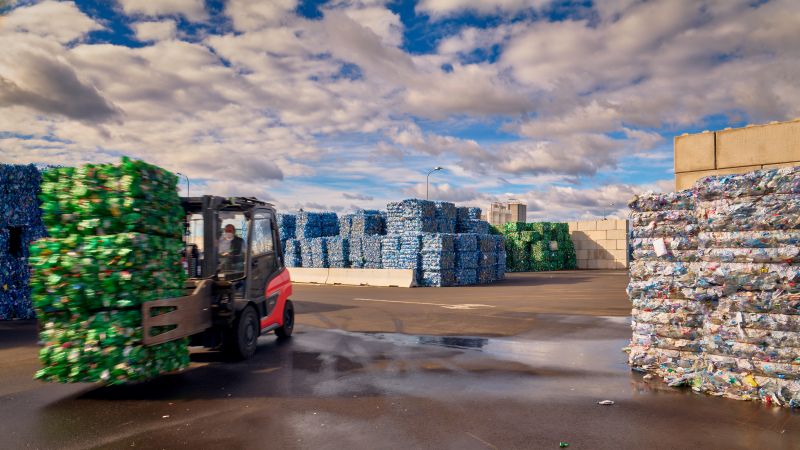
To maximize sustainability, the company has set a target for 2026 to convert all five of its outdoor forklifts to fully electric drives. Given that the five vehicles operating indoors are already electric, this move sets a new benchmark for operational safety and energy efficiency. Additionally, plans are underway to fully automate the removal of bale wires. Previously performed through time-consuming manual labor, this modernization project is scheduled for completion in autumn 2026.
The growing public interest in the PET recycling loop is reflected in a high volume of requests for plant tours. Transparent knowledge transfer remains a high priority for the company, with a particular focus on educating the younger generation about the practical processes of the circular economy.
References and Official Sources:
-
Original Official Publication (PET to PET Recycling Österreich GmbH): Halbjahresbilanz 2026: PET to PET recycelte beachtliche 17.101 Tonnen PET-Flaschen
