





If you like our site, mark us as a preferred source on Google — so you’ll see our articles more often in search!
★Mark us as a preferred sourceBritain’s waste system routinely writes off repairable electronics that could keep working for years. That is the central claim of a University of Surrey study presented on 30 September 2026 and published in the journal Business Strategy and the Environment. The authors, Sheeba Pathak (Surrey Business School) and Hajar Fatorachian (Leeds Beckett University), compared a municipal recycling centre with a volunteer-run Repair Café, then used operations research models to work out how the two worlds could be joined into one system.
The headline result is striking: only 2–2.5 percent of devices arriving at the recycling centre are judged fit for reuse, while 78 percent of the items taken to Repair Cafés are either fixed or repairable. Below we explain in plain terms what the researchers examined, what they found, where the study is strong and where it is weak, and what it means for e-waste management beyond the UK.
In short: According to the University of Surrey study, a large share of repairable electronics in Britain goes straight to shredding instead of repair: only 2–2.5 percent of devices at the observed recycling centre are reused, while Repair Café data suggest 78 percent could be saved. The authors propose that recycling centres act as hubs routing devices to repairers, and that community repair be given a formal role and funding.
What did the Surrey researchers examine?
The study set out to answer three questions: why the e-waste reverse logistics chain needs to be designed in a quantitative, “formalised” way; at which points of the chain mathematical optimisation can help; and how such a system can be cost-efficient, lean and environmentally sound at the same time.
The researchers drew on four sources:
- An open database: 10,678 repair records across 40 product categories from the Open Repair Alliance’s UK data (covering the period up to September 2023).
- Site observation: the lead author carried out gemba visits – first-hand observation of the actual work processes – at the Slyfield Recycling Centre near Guildford, Surrey, and at the Guildford Repair Café, where she also took part in a repair.
- Government data: emission factors from the UK Department for Environment, Food & Rural Affairs (DEFRA) were built into the transport calculations.
- Models: a trans-shipment network model, a decision tree solved with branch-and-bound, queueing theory and a material recovery calculation.
The study rests on two frameworks developed by the authors. PURE (Profitable, Unified, Resilient, Efficient) describes the strategic level, while CReW (Circular Reverse E-Waste) describes the operational chain: households → repair workshops and community maker spaces → material recovery centres → the industries that use the recovered raw materials.
Why do repairable electronics end up in the bin?
The most quoted finding of the study is the contrast between two numbers. At the Slyfield recycling centre, roughly 2–2.5 percent of incoming devices are considered suitable for reuse, and these are resold by the county. Everything else goes to partner firms: televisions to a processor in Kent, fridges to a plant in East Sussex and small appliances to another Kent processor, where they are shredded and their metals recovered.
By contrast, the Repair Café database shows that of the items brought to repair cafés:
- 50 percent were fixed on the spot,
- 28 percent were classed as repairable (for example, waiting for a spare part),
- 22 percent had genuinely reached the end of their life.
The researchers conclude that repairable electronics are not a marginal category but a volume worth planning capacity for. Today the British system follows a “collect and dispatch” logic, while repair remains a volunteer activity of a few hours a month, disconnected from the formal chain.
One professional caveat is worth keeping in mind: the two numbers do not measure the same population. People take to a Repair Café the devices they themselves believe can be saved and want to keep. A recycling centre, on the other hand, receives everything, from a smashed fifteen-year-old printer to a dried-out ink cartridge. So the 78 percent does not mean that 78 percent of recycling-centre items could be repaired. The gap is still telling: the real figure lies somewhere in between, and certainly well above 2 percent.
Where devices “leak” out of the system is a topic we have covered before: Europe does not recycle most of its e-waste but exports it, often labelled as “used goods”. The Surrey study also cites the older figure that in 2009 only 17 percent of UK e-waste passed through legitimate recycling channels.
How long before a device becomes waste?
One novel element of the study is that it adds a time dimension to the definition of e-waste. Repair Café records include both the manufacturing date and the date of arrival for repair, so it is possible to calculate at what age a product typically breaks down or becomes unwanted.
Some average ages at the point of a repair attempt:
- headphones: 4.43 years,
- mobile phones: 4.54 years,
- tablets: 5.41 years,
- kettles: 5.94 years,
- coffee makers: 7.00 years,
- vacuum cleaners: 7.19 years,
- laptops: 7.60 years,
- desktop computers: 9.26 years,
- games consoles: 11.33 years,
- sewing machines: 27.61 years,
- watches and clocks: 28.21 years,
- projectors: 30.92 years.
Most categories reach this point between 4 and 8 years. According to the authors, this is practical planning data: where lifespans are short (phones, headphones), more frequent collection and fast repair capacity are needed, while for long-lived products (sewing machines, hi-fi) skills and spare-part availability are key.
We recently covered the problem of cheap, short-lived devices in detail: according to the WEEE Forum’s fast tech survey, 57.9 percent of Europeans can recall a gadget that lasted six months or less.
What did the researcher see at the recycling centre?
The Slyfield Recycling Centre is run for the county council, with operations outsourced to SUEZ. It employs 19 people and collects around 40 waste categories. The researcher drew a Value Stream Map of the site, a lean management tool that shows how much time is spent on genuinely value-adding work and how much on waiting.
The observed process in a nutshell:
- incoming items are inspected by hand, and those that look usable are set aside in a dedicated area;
- some devices undergo only a basic Portable Appliance Test (PAT), essentially checking whether they switch on;
- 40-yard containers are collected once they are about three-quarters full, when the processing partner is called.
According to the map, total lead time is close to seven and a half days, of which value-adding work accounts for only 2 hours 20 minutes. The researcher recorded several weak points: waste is not always assigned to the correct bin, there is too little space for e-waste on collection vehicles, a single entry and exit point causes congestion, revenue streams and repair receive little attention, and devices are often left unprotected from the weather. From a professional perspective the last point hurts most: a working device left standing in the rain really does become waste within days.
Repair Café: from volunteers to a service?
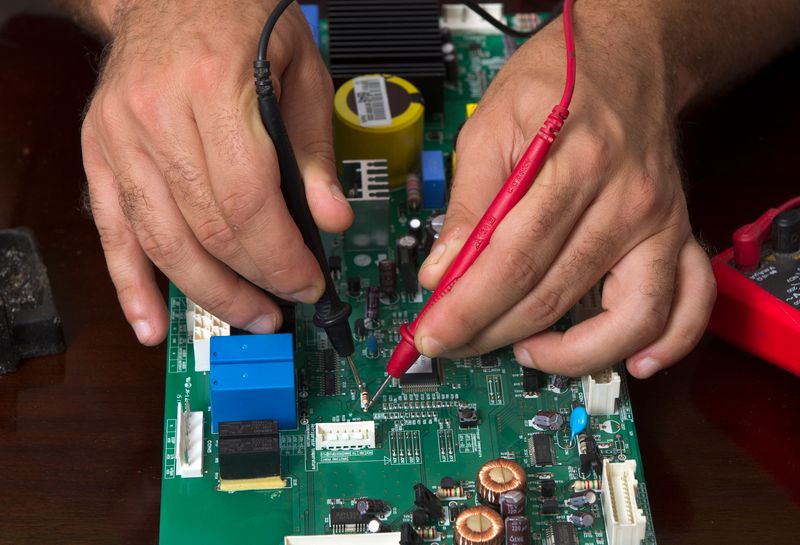
The Guildford Repair Café opens once a month, on the third Saturday, for two hours. Each session can host 20–30 visitors, each bringing up to two items, receiving a queue number and signing a declaration. Two or three volunteers handle electronic repairs, each taking 20–30 minutes per item.
The researchers asked: what if the recycling centre routinely sent repairable electronics here? A queueing model showed that two hours a month falls short by orders of magnitude. According to the model, the additional demand would mean roughly 1,300 labour hours a week, requiring a repair team of 40–50 part-time and full-time staff, two shifts a day and around £13,000–14,000 in weekly wages, with a maximum of 15 repairers per shift because of space constraints.
Some of the detailed figures in the paper are not fully consistent, so they are best read as order-of-magnitude illustrations. The message, however, is clear: if repair is taken seriously, it cannot remain a volunteer hobby; it becomes a planned, paid service that needs capacity, training and funding.
Repair, harvest parts or recycle: the decision tree
The study also modelled what should happen to a device when it arrives at a repair workshop or maker space. The first question in the decision tree is whether to disassemble it. Four paths then open up: use (in a new or another product), repair, send on for material recovery, or dispose. Each branch ends in selling or renting.
The authors weighted cost, emissions and time equally and assigned scores to each decision. In this model the best route was not to disassemble the device but to keep it in use and rent it out rather than sell it. It is important to note that the scores are assumed values, not measured costs and emissions, which the authors acknowledge themselves. The value of the method lies less in the specific result than in making the decision transparent and comparable.
For the modelled material flow network (households → repair points → processors → end-use industries), the authors used Excel Solver to find the routes with the lowest transport emissions. The choice is deliberate: a spreadsheet tool is available to every municipality, which makes the method easy to replicate.
Urban mining: how much copper is in our phones?
The study devotes a section to material recovery from mobile phones, often referred to as urban mining. Citing a widely quoted industry estimate, the authors note that metal recovered from e-waste can be up to 13 times cheaper than mined metal.
The calculation starts from an expected demand of 31 million mobile phones by 2029, at an average of 190 grams each, giving around 5,890 tonnes. About 40 percent of this mass is plastic (2,356 tonnes), of which 471 tonnes could be recovered at a 20 percent recovery rate.
For copper, however, the final figure in the paper (1.94 tonnes, or 1.75 tonnes at 90 percent recovery) appears to be a calculation error: the stated inputs (5,890 tonnes of devices, 206–451 grams of copper per kilogram) point to hundreds or even thousands of tonnes, not a couple of tonnes. The authors’ main conclusion still holds: secondary raw materials complement but do not replace mining, and copper, thanks to its high recovery efficiency, is one of the most promising material streams.
The study’s policy recommendations go beyond the models:
- Producer-financed collection: strengthening extended producer responsibility (EPR) so that producers bear the cost of collection. The study cites DEFRA’s 2024 consultation of more than 320 organisations: 64 percent supported producer-financed household collection and 76 percent backed mandatory take-back by online marketplaces.
- Recycling centres as hubs: centres should not only collect and forward, but route devices towards repair, parts harvesting and recycling.
- Recognition for community repair: Repair Cafés and maker spaces should receive formal recognition, funding and skills support rather than remaining isolated volunteer initiatives.
- Data-driven planning: municipalities and authorities should use optimisation tools to design collection and recovery networks.
In the press release, the lead author argued that too many electrical products are declared waste before anyone has properly checked whether they can be repaired, and that greener operations are not necessarily more expensive. In her view, Repair Cafés already show what is possible, but goodwill alone will not solve the problem.
You can read more about the economics of producer responsibility in our article on the US EPR analysis.
A professional view: strengths and limitations
The study’s greatest strength is that it treats in a single framework what is fragmented in practice: collection, repair, material recovery and service capacity. UK research has so far tended to optimise isolated sub-problems such as routing or facility location. It is also a strength that the work is grounded in real site observations and uses a tool (Excel Solver) that any local authority can access.
The authors list some of the limitations themselves:
- Deterministic models: fluctuations in return volumes, household behaviour and capacity are not captured.
- Assumed data: several values in the transport network and the decision tree are hypothetical.
- One country, two sites: the results are tied to the UK regulatory and institutional context.
- Calculation inaccuracies: both the capacity and the copper calculations contain values that are inconsistent or appear to be wrong.
None of this makes the research worthless, but it does mean that its logic is more transferable than its specific numbers: the recycling centre should be a distribution point in the chain, not its end.
What does this mean beyond the UK?
The British picture will look familiar in many European countries. Recycling centres are the main drop-off point for household e-waste, and the system is optimised mainly for collection and material recycling. Repair relies largely on commercial service shops and scattered community initiatives.
A few related developments we have covered:
- The right to repair: the EU’s Directive 2024/1799 is designed to make repair more attractive than replacement, but as our article on the latest NIM study shows, consumers often misunderstand what it means in practice.
- Extending device life with software: initiatives such as the Back Market and Google ChromeOS Flex pilot show that older laptops can be kept in use instead of being scrapped.
Perhaps the most important lesson from the Surrey study is that the quality of sorting determines what can return to use. If working devices arriving at recycling centres were stored under cover, given a real condition assessment rather than a simple switch-on test, and had a channel to reach a repairer, part of the gap between 2 percent and 78 percent could turn into local jobs and savings. That requires not only enthusiastic volunteers but also funding, skills training and incentives built into producer responsibility schemes. For households, the simplest step is this: before dropping off a broken device, ask a repair shop or a Repair Café first.
Frequently asked questions about repairable electronics
What did the University of Surrey study examine about repairable electronics?
The study examined why repairable electronics end up as waste in Britain and how this could be prevented. The authors analysed 10,678 Repair Café repair records, carried out site observations at a Surrey recycling centre and a Guildford Repair Café, and then used operations research models to design a system linking collection, repair and material recovery.
Why is the gap between the recycling centre and Repair Café figures so large?
Partly because the two numbers measure different populations. At the recycling centre only 2–2.5 percent of devices are judged reusable, because everything arrives there and usually only a basic switch-on test is carried out. People take items they believe can be saved to Repair Cafés, and 78 percent of these are repairable. The real figure lies in between, but well above 2 percent.
How many years does it take for electronics to become waste, according to the study?
Most product categories reach repair or disposal between 4 and 8 years of age. On average, mobile phones arrive at Repair Cafés at 4.54 years, headphones at 4.43 years and laptops at 7.60 years, while sewing machines, clocks and projectors last 27–31 years. The authors argue that this time dimension helps plan collection and repair capacity.
What do the researchers recommend to reform the UK e-waste system?
The researchers recommend that recycling centres act as distribution hubs, routing devices to repairers, parts harvesting and recycling. They also call for stronger producer-financed collection, mandatory take-back by online marketplaces, and formal recognition, funding and skills support for Repair Cafés and maker spaces instead of leaving them as isolated volunteer initiatives.
How reliable are the study’s models and figures?
The logic of the models is useful, but the specific figures should be treated with caution. The models are deterministic, several inputs are assumed, and the capacity and copper calculations contain values that are inconsistent or appear to be wrong. The study’s real strength is that it handles collection, repair and material recovery in a single framework grounded in site observations.
What does the study mean for countries beyond the UK?
The lesson applies widely, because many European systems are also built mainly around collection and material recycling. If recycling centres stored working devices under cover, assessed their condition properly and passed them on to repairers, more products could stay in use. This requires funding, skills training and incentives built into producer responsibility schemes, not volunteers alone.
🔗 Official sources and references: 👉
- Pathak, S. & Fatorachian, H. (2026): Operations Research-Based Formalisation and Design of Sustainable Reverse Logistics for E-Waste Supply Chains. Business Strategy and the Environment, open access.
- University of Surrey: Britain’s recycling system is writing off electronics that could be repaired (press release, 30 September 2026)
Consistent structure, quick answers: every article is built so that both readers and AI search tools can find the key points easily. Our content is produced with the help of AI tools and reviewed by our editor.
