





If you like our site, mark us as a preferred source on Google — so you’ll see our articles more often in search!
★Mark us as a preferred sourceAluminum recycling is one of the simplest and most effective ways to save energy, yet one of the world’s largest economies buries billions of beverage cans every year. On 23 September 2026, timed for Climate Week NYC, UK-based Greyparrot – a pioneer of AI-powered waste analytics – published its report The energy nobody is counting. Built on object-by-object data from a sorting facility in Brooklyn, it draws an uncomfortable parallel: while the electricity consumed by AI data centers is tracked to the last megawatt-hour, the energy embedded in metal sent to landfill appears on no dashboard at all.
In short: Aluminum recycling uses 95.5 percent less energy than making new metal from bauxite, yet the United States sends 61 billion beverage cans to landfill every year. Greyparrot’s AI cameras show that the Sunset Park facility in Brooklyn recovers 89 percent of the aluminum that reaches it, meaning the loss happens at collection, not on the sorting line.
Everyone counts AI’s electricity – who counts the landfill?
Data center electricity demand has become one of the most closely watched numbers in the economy. According to Lawrence Berkeley National Laboratory’s 2024 report, US data centers consumed 176 terawatt-hours (TWh) in 2023, or 4.4 percent of all US electricity.
Greyparrot set the landfill ledger against that figure. Every buried can has to be replaced with new metal smelted from bauxite, one of the most energy-intensive industrial processes there is – and mostly abroad, since the US imports around 60 percent of the aluminum it uses. According to the Aluminum Association and the Can Manufacturers Institute (CMI), replacing the cans landfilled each year takes roughly 11 TWh. That is about 6 percent of data center consumption: small enough that nobody built a system to measure it, the report argues, but large enough to be a scandal in almost any other industry.
Why is aluminum recycling the clearest case?
Because the arithmetic is settled. According to the International Aluminium Institute (IAI), producing secondary, remelted aluminum takes 95.5 percent less energy than primary production from ore. In the report’s comparison this is the widest gap of any everyday material: savings are around 85–90 percent for HDPE, about 75 percent for PET, 60–65 percent for steel and 25–30 percent for glass.
Aluminum also recycles indefinitely without losing quality: a can becomes a can again and can be back on a store shelf roughly 60 days after collection. It has real scrap value too – the report uses a figure of about $1,275 per US (short) ton.
The US balance sheet is still grim. In 2023, of 107 billion cans shipped, only 46 billion (43 percent) were recycled, while 61 billion (57 percent) went to landfill, worth around $1.2 billion. The Aluminum Association describes this as the lowest US rate in decades. Meanwhile, the country imported $26.5 billion worth of aluminum in 2025. As the report puts it, those two facts sit in different government departments and are almost never put on the same page: America buries the metal, then buys it back from abroad.
Brooklyn: 89 percent on the line, 43 percent nationally
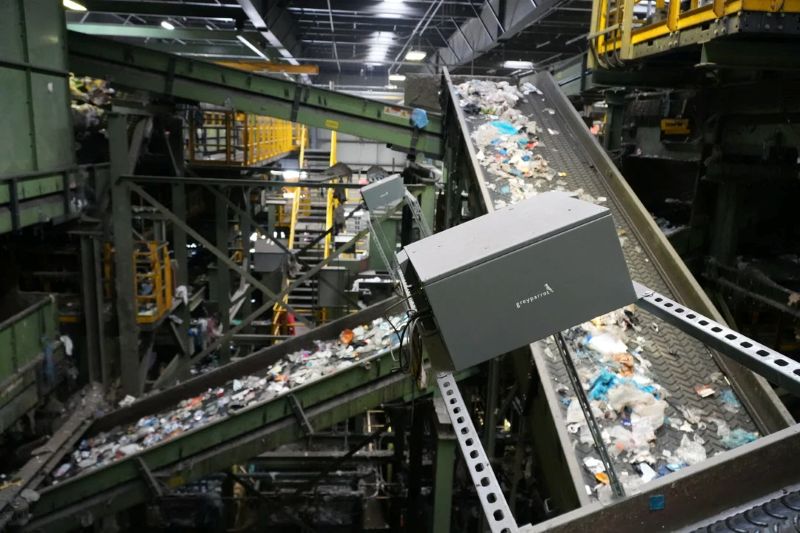
The research took place at the Sunset Park materials recovery facility (MRF) in Brooklyn, operated by Circular Services. Greyparrot Analyzer units mounted above the sorting lines classify every object passing beneath them by material and format, continuously, all day. As far as the company knows, this is the first time New York’s recycling stream has been measured object by object at this scale rather than estimated by weight.
The result: the facility recovers 89 percent of the aluminum that arrives – about 91,000 cans a day, or roughly 33 million a year. The report’s central message follows from this: sorting is not the bottleneck. Once aluminum reaches a modern facility, nearly nine cans in ten are recovered. The problem is that most cans never get there; they go in the wrong bin and end up in landfill. Greyparrot therefore stresses that sorting technology must be paired with investment in public education.
“Recycling is the foundation of domestic supply chains. The aluminum moving through our facilities is a domestic commodity stream, and now we can measure it in real time,” said Ron Gonen, CEO of Circular Services.
One more can, at national scale
One of the report’s most striking sections calculates what would happen if every American – 341.8 million people – recycled just one additional can, once. At 14 grams per can that is 5,275 US tons (about 4,785 metric tonnes) of aluminum, which according to Greyparrot’s calculations would:
- capture around $6.7 million in scrap value,
- save 58,866 MWh of energy, roughly the annual electricity use of 5,600 US homes,
- avoid 33,736 tonnes of CO₂e, equivalent to about 7,300 passenger cars for a year.
No new plant or policy is required, the report emphasizes – just a habit.
If every can came back
The “ceiling” scenario asks what would happen if the US recycled 89 percent of all cans shipped – the rate Sunset Park achieves on the material that reaches it. That would mean an additional 49.2 billion cans a year, or about 759,000 US tons (around 688,000 metric tonnes) of aluminum. According to the calculation, this would:
- return $968 million in value to the domestic supply chain,
- save 8.5 million MWh (8.5 TWh) of energy, enough for about 807,000 homes for a year – effectively every household in Manhattan,
- avoid 4.9 million tonnes of CO₂e, equivalent to taking about 1.1 million cars off the road.
By Greyparrot’s own estimates, the recovered metal could make 450 million bicycle frames or 20,500 single-aisle airliners a year, and would weigh as much as 3,400 Statues of Liberty. That works out to 1,560 cans rescued every second, all year round. The authors are clear: this is a scenario, not a forecast, and it makes no assumption about how that rate would be reached.
How does Greyparrot Analyzer work?
The London-based company’s camera system sits above sorting belts and identifies waste in real time by material, product type and even brand. Analyzer now operates in seven US states and more than 20 countries, has surpassed 1 trillion waste detections, and counts Veolia, Biffa and FCC among its customers alongside Circular Services.
The key shift is in how measurement works. Recycling has traditionally been measured by the truckload: weight in, weight out, with the composition in between inferred from a few hand-sorted samples of a few hundred kilos, a few times a year. Analyzer counts every object instead, turning an annual estimate into an operational number that can be managed daily – a facility that is metered rather than sampled. According to the company, facilities using its data are seeing 10–30 percent efficiency gains, with more than $2 million in savings in a single year at some sites, driven largely by recovering high-value plastics and aluminum previously lost to residue.
“Every era of computing has made something invisible legible, and waste is the last unindexed system in the global economy,” said Ambarish Mitra, co-founder of Greyparrot. Mikela Druckman, co-founder and CEO, says waste intelligence shows what is in the stream in real time, giving recyclers, brands and policymakers better information to act on.
What does this mean for Hungary and Europe?
Europe is well ahead of the United States: the recycling rate of aluminum beverage cans in Europe has reached a record 76 percent, with the best results in countries running deposit return systems (New Record in European Circularity: Aluminum Beverage Can Recycling Hits Historic High). Hungary has come a long way as well: back in 2017, around half of recyclable cans in the country still ended up in the general waste bin.
Since 2024, Hungary has operated a mandatory deposit return system (DRS) run by MOHU, with a 50-forint deposit on single-use metal beverage cans. The system keeps developing, including bulk-feed REpont machines that accept whole bags of containers at once.
The lesson of Greyparrot’s report applies here too: the most expensive can is the one that never comes back. A deposit can belongs at a REpont, not in mixed waste. Non-deposit aluminum packaging (food tins, trays, foil) should go into local separate collection. Here, aluminum recycling really does come down to a single habit.
An expert’s view: reading between the numbers
The report is strong and well documented, but a few points deserve a careful read. The 89 and 43 percent figures are two different measures: the first refers to aluminum arriving at the facility, the second to all cans sold nationally. The methodology section says so itself – the gap between them reflects collection losses, not sorting efficiency. It is also worth noting that the press release at one point says fewer than four in ten cans are recycled nationally, which does not match the report’s 43 percent figure.
The 11 TWh is the full energy cost of replacing landfilled metal; the actual saving from recycling is 95.5 percent of that. And since much primary smelting happens outside the US, part of the energy saved would be saved abroad rather than on the American grid – so the “easing the strain on US power grids” argument holds only in part. The measured data come from a single New York facility, the national scenarios assume uniform application, and the report was produced by a technology company with a commercial interest in measurement. None of this weakens the main message: what is not measured cannot be improved, and the energy stored in aluminum really is missing from the energy policy debate.
Frequently asked questions about aluminum recycling
How much energy does aluminum recycling save?
According to the International Aluminium Institute, aluminum recycling uses 95.5 percent less energy than producing new metal from bauxite. That is the largest saving among everyday packaging materials: around 75 percent for PET, 60–65 percent for steel and 25–30 percent for glass. Aluminum can also be remelted indefinitely without any loss of quality.
What did Greyparrot measure at the Brooklyn sorting facility?
Greyparrot Analyzer cameras classified every object on the belts at the Sunset Park facility operated by Circular Services. They showed that the plant recovers 89 percent of the aluminum that arrives, about 91,000 cans a day or roughly 33 million a year. In other words, sorting works well, and the losses happen earlier, at collection.
Why do so many aluminum cans end up in US landfills?
Because most cans never reach a sorting facility. In 2023, of 107 billion cans shipped in the US, only 46 billion were recycled and 61 billion went to landfill. Greyparrot’s data show that modern facilities recover nearly 90 percent of the aluminum they receive, so the missing link is household collection and public education.
What would happen if every American recycled one more can?
According to the report, 341.8 million additional cans would add up to about 4,785 metric tonnes of aluminum. That would capture around $6.7 million in scrap value, save 58,866 MWh of energy – roughly the annual use of 5,600 US homes – and avoid 33,736 tonnes of CO₂e, with no new plant or policy required.
How does Greyparrot Analyzer work?
Greyparrot Analyzer is an AI-powered camera system mounted above sorting belts that identifies waste in real time by material, product type and brand. Instead of estimating composition from occasional hand-sorted samples, it counts every object. The system operates in more than 20 countries and has already recorded more than 1 trillion waste detections.
How can I help aluminum cans get recycled in Hungary?
The most important step is to return deposit-bearing beverage cans to a REpont return point, where you get a 50-forint refund per can. Non-deposit aluminum packaging, such as food tins, trays or foil, should go into local separate collection.
Sources:
- Greyparrot press release (23 September 2026): Reducing the Tech Sector’s Energy Crunch with Recycled Aluminum
- Greyparrot report: The energy nobody is counting
- Aluminum Association / Can Manufacturers Institute, 2023: can recycling data
- International Aluminium Institute: 95% energy saving
- US Geological Survey: Mineral Commodity Summaries 2026 – Aluminum
