





If you like our site, mark us as a preferred source on Google — so you’ll see our articles more often in search!
★Mark us as a preferred sourceIn short: The BMW Group has launched the practical testing of an 18-tonne truck equipped with a hydrogen combustion engine at its Leipzig plant, operating almost entirely CO2-free by emitting water vapor based on adapted diesel technology. Funded by the German Federal Ministry for Digital and Transport (BMDV) under the HyCET project, the initiative aims to evaluate the practical viability of hydrogen logistics, focusing on short refueling times, high payload capacities, and suitability for multi-shift operations.
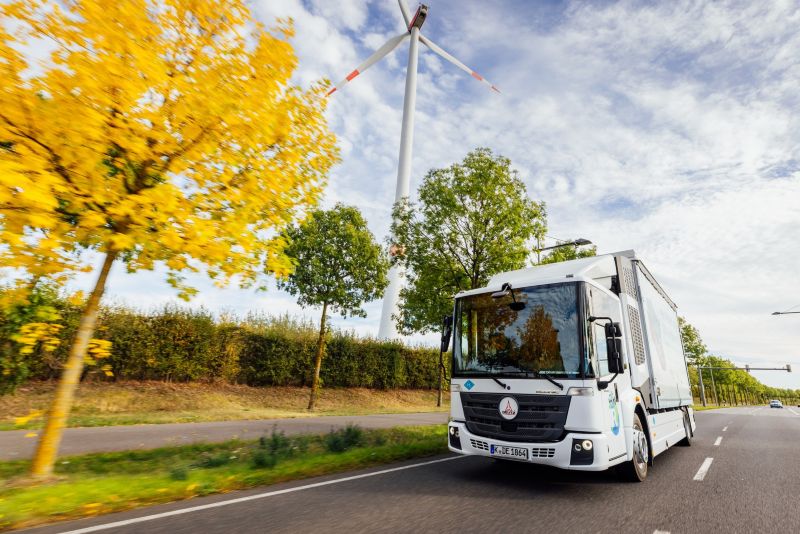
Taking a monumental step towards a sustainable future and greener transportation, the Bavarian automaker has officially commenced real-world trials. The new BMW hydrogen truck has entered daily logistics operations at the company’s Leipzig plant. This significant innovation aims to drastically reduce carbon dioxide emissions while providing a robust alternative to battery-electric propulsion in the heavy-duty commercial vehicle sector.
The role of the BMW hydrogen truck in practical logistics
At the BMW plant in Leipzig, the practical testing of an 18-tonne truck powered by a hydrogen combustion engine has begun in regular daily plant traffic. In this highly specialized vehicle, hydrogen is burned inside a piston engine based on proven diesel technology. The primary environmental advantage of this process is that it operates almost entirely CO2-free, releasing nothing but harmless water vapor through the exhaust into the atmosphere.
During the initial phase of the current project, this innovative BMW hydrogen truck is tasked with supplying the Technology Exterior Components (TEK) facility at the Leipzig plant. Its daily responsibilities are crucial: transporting various plastic parts necessary for the production of modern vehicles, including essential components like bumpers and spoilers. According to the roadmap, the project will soon transition into its second phase. In this subsequent stage, the hydrogen-powered vehicle will directly supply the vehicle assembly lines with exterior components from the TEK in a strictly just-in-time logistics system, proving its reliability in a time-critical environment.
The importance of technological openness and real-world trials
Dirk Wiedmann, Head of Production Network and Logistics at the BMW Group, emphasized the strategic importance of this initiative. He explained that logistics forms the absolute backbone of their production processes. Consequently, the company maintains a strictly data-based and technology-open approach to identify the most suitable alternative truck drive for every specific logistics application.
Wiedmann highlighted a historic milestone: for the very first time in the history of German automotive production, a truck featuring a hydrogen combustion engine is being utilized in regular, daily operations. The testing phase is not limited to a short demonstration; the vehicle is being rigorously tested on longer transport routes and operates in a continuous three-shift system within the plant environment. The practical insights and data gained under these real-world conditions are absolutely essential for identifying the most suitable future deployment profiles for hydrogen combustion engines in the logistics industry.
The synergy between battery-electric and hydrogen-based solutions
Industry experts agree that pure battery-electric trucks and hydrogen-powered commercial vehicles are not mutually exclusive; rather, they perfectly complement one another. Hydrogen-powered trucks are considered the optimal choice for the most demanding transport profiles. These challenging scenarios include tasks requiring very high daily mileage, continuous multi-shift operations without long breaks, or regions facing specific infrastructural limitations.
A massive advantage of hydrogen propulsion is the incredibly short refueling time, which minimizes vehicle downtime and thereby maximizes the overall efficiency of the logistics fleet. Furthermore, these vehicles can be excellently deployed in regions where an adequate electric charging infrastructure is currently unavailable, or where the local power grid capacity cannot support the installation of high-power fast chargers. However, unlocking these benefits requires the establishment of a suitable and reliable hydrogen filling station network. As highlighted in our previous article, the Hydrogen Council urges the spread of hydrogen technology, expanding this infrastructure is a pivotal requirement for the successful green transition of the industrial sector.
Proven diesel technology presented in a new, green format
The hydrogen combustion engine utilized in this project is fundamentally based on diesel technology that has been perfected over many decades. This specific technical engineering choice carries enormous practical advantages: the new engines can be integrated into existing vehicle architectures and maintenance structures with remarkable ease. This high level of compatibility can drastically accelerate the market introduction and ramp-up phase of hydrogen combustion technology, bypassing the need to completely overhaul service networks.
Even under heavy loads and during highly dynamic, rapidly changing driving profiles, the hydrogen engine delivers excellent performance and robustness completely comparable to traditional diesel engines. When compared to hydrogen fuel cells, the internal combustion engine presents additional operational benefits: it is significantly less sensitive to the varying qualities and purity levels of hydrogen available on the market. This tolerance guarantees a much higher level of availability and reliability in the demanding, physically rigorous logistics sector.
The HyCET project and strategic sustainability objectives
The real-world testing in Leipzig is an integral part of the large-scale HyCET (Hydrogen Combustion Engine Trucks) research and development project. This forward-looking initiative is heavily supported by the German Federal Ministry for Digital and Transport (BMDV), with the clear objective of developing and testing heavy-duty vehicles with hydrogen combustion engines under genuine, everyday logistics conditions. Led by the BMW Group, the project brings together a consortium of excellent partners who pool their respective expertise in vehicle development, infrastructure construction, and practical logistics operations.
The hydrogen engine undergoing testing was developed by the renowned DEUTZ company. The vehicle itself is operated in daily traffic by the Rudolph Logistik Gruppe, while the necessary hydrogen refueling stations were constructed by TEAL MOBILITY. The shared goal of this consortium is to gather robust, reliable data for the comprehensive technical, operational, ecological, and economic evaluation of the technology. Ultimately, the HyCET project aligns perfectly with the overarching “BMW Group Strategy for Reduced Logistics Emissions,” which focuses on reducing carbon emissions across global transport operations. During the technology-neutral assessment of alternative drive solutions, BMW meticulously considers technical maturity, reliability, operational capability, CO2 reduction potential, economic feasibility, and the availability of the required energy and refueling infrastructure.
FAQ
Why is the testing of the BMW hydrogen truck important?
This real-world testing is historically significant because it is the first time in German automotive production that a truck with a hydrogen combustion engine is being used in regular daily logistics, including demanding three-shift operations, helping to optimize future zero-emission transport.
What engine powers the hydrogen truck?
The vehicle is powered by a piston combustion engine based on proven diesel technology, developed by DEUTZ. By combusting hydrogen, the engine operates almost entirely CO2-free, emitting only harmless water vapor from the exhaust.
Which project supports this hydrogen initiative?
The trials are a core component of the HyCET (Hydrogen Combustion Engine Trucks) research and development project, funded by the German Federal Ministry for Digital and Transport (BMDV). The consortium includes the BMW Group, DEUTZ, Rudolph Logistik Gruppe, and TEAL MOBILITY.
Source:
