




If you like our site, mark us as a preferred source on Google — so you’ll see our articles more often in search!
★Mark us as a preferred sourceE-cigarette recycling is a crucial element of modern environmental protection. According to the latest professional report from the Swiss organization SENS eRecycling, the consistent collection and proper processing of vapes recovers significant amounts of valuable raw materials while drastically reducing the safety risks associated with waste management.
In short: In 2025, the SENS eRecycling network collected over 72 tons of e-cigarettes across Switzerland. Although the national collection rate remains at just 28 percent, e-cigarette recycling successfully recovers highly valuable secondary materials such as cobalt, lithium, copper, and nickel. Incorrectly discarded vapes pose a severe fire hazard due to their built-in lithium-ion batteries, making proper collection critical for both human safety and ecosystem preservation.
The E-cigarette recycling Process and Technological Results
In 2025, SENS eRecycling collected a total of 72 tons of e-cigarettes throughout Switzerland, transporting them to licensed Swiss partner companies for processing. This recycling procedure requires utmost care: the e-cigarettes and their lithium-ion batteries are first discharged in a water bath according to the latest technological standards. This initial step is absolutely essential to prevent short circuits and subsequent fires.
Following the discharge, the devices are shredded and separated into various material fractions, yielding iron, other metals, and plastics. From an ecological standpoint, the most valuable output is the powdery “black mass” (Schwarzmasse). A detailed 2025 analysis by SENS eRecycling revealed that this mass contains graphite, lithium, copper, nickel, and a significant proportion of cobalt.
Nando Erne, Communications Manager at SENS eRecycling, highlighted that the high percentage of cobalt clearly demonstrates the importance of this process: cobalt is present in a much higher concentration in e-cigarettes than lithium itself, which ironically gives the batteries their name.
Environmental Benefits and Obstacles to Increasing Collection Rates
Regular material analyses provide SENS and its partners with vital data to continuously refine their recycling technology. Currently, the processing of vapes contributes only 0.1 percent to the total environmental benefit of SENS eRecycling. However, with ongoing technological advancements and anticipated increases in volume, this share is expected to grow substantially in the future.
The greatest challenge remains consumer behavior: 72 percent of all sold disposable e-cigarettes are still disposed of incorrectly, and the overall collection rate is a mere 28 percent. A joint study by SENS and the University of Applied Sciences Northwestern Switzerland (FHNW) found that many users simply do not realize that e-cigarettes are classified as electrical appliances, leading them to use the nearest trash can out of convenience. As noted in our article about e-waste disposal, throwing such devices into municipal waste results in a massive loss of resources.
Safety Risks and Free Collection Alternatives
Every incorrectly disposed e-cigarette represents a critical safety risk. Damaged lithium-ion batteries frequently trigger severe fires at collection points, in garbage trucks, and inside waste incineration plants. Therefore, SENS eRecycling strongly urges consumers to adopt proper disposal habits.
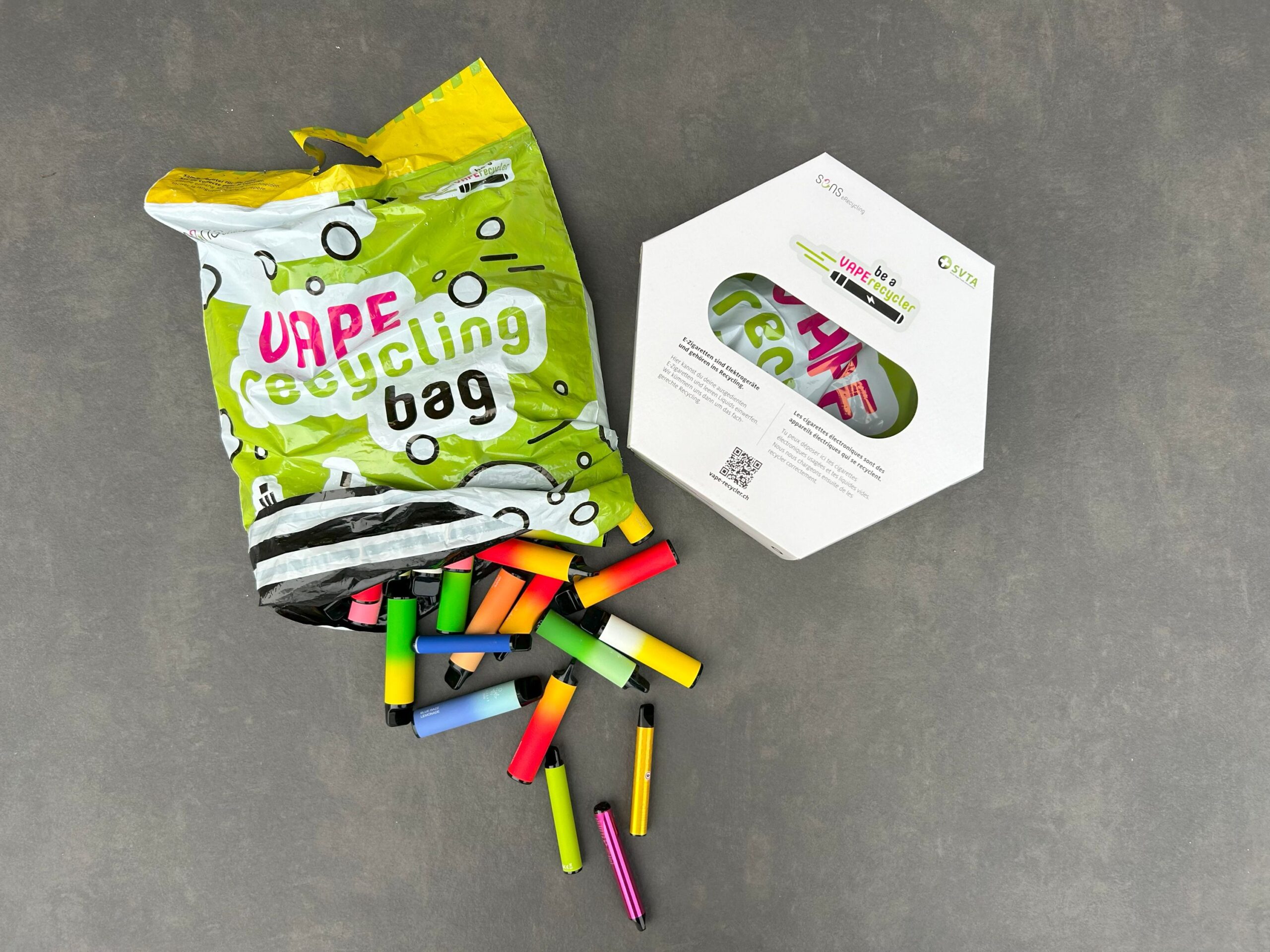
In Switzerland, over 630 SENS collection points accept e-cigarettes free of charge. In addition to specialized retailers, users can order a free “Vape Recycling Bag” online. They can fill this bag at home and simply place it in their mailbox, from where the Swiss Post picks it up for free. (Further details about the initiative can be found on the original Schaffhausen24 publication).
The Strategic Role of Cobalt in the Global Ecological Footprint
Recent analyses confirm that e-cigarettes are a highly relevant secondary raw material source, largely due to their high cobalt concentration. This metal is an indispensable building block for lithium-ion batteries used in smartphones, e-bikes, laptops, and vapes: it acts as a stabilizer, increases energy density, and prevents overheating.
Since cobalt is predominantly mined in the Democratic Republic of Congo—often under extremely difficult social and ecological conditions—every correctly recycled e-cigarette helps keep this strategic raw material in the economic loop, directly improving the global life cycle assessment (Ökobilanz). Established in 1990, the SENS foundation (a member of Swiss Recycle and the global WEEE Forum) continues to set pioneering standards in this vital sector.
FAQ
Why is e-cigarette recycling important?
Because correctly disposed vapes allow for the recovery of valuable secondary raw materials such as cobalt, lithium, copper, and nickel, while also preventing severe fire hazards.
What are the risks of incorrectly disposing of vapes?
Due to their lithium-ion batteries, e-cigarettes thrown into municipal waste can ignite and cause devastating fires at collection points, in garbage trucks, and in waste incineration plants, endangering both the public and the environment.
How are e-cigarettes processed in Switzerland?
SENS eRecycling partners first discharge the devices in a water bath to prevent short circuits, then shred them. Afterward, they separate the materials into metals, plastics, and the ecologically highly valuable black mass.
