




If you like our site, mark us as a preferred source on Google — so you’ll see our articles more often in search!
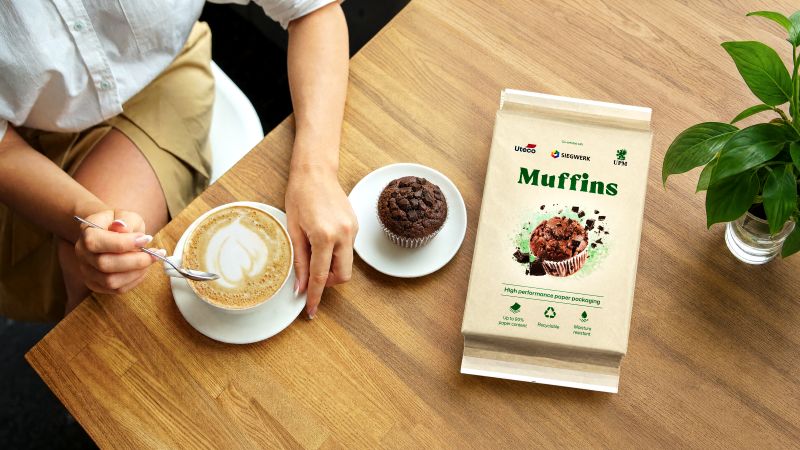
★Mark us as a preferred sourceA new, industrially efficient paper-based secondary packaging solution has been developed through a technological collaboration between UPM Specialty Materials, Siegwerk, and Uteco. Announced on October 20, 2026, the joint innovation serves as a practical entry point for brand owners seeking to reduce plastic use and increase renewable material content, enabling paper levels of up to 90 percent while remaining fully recyclable within standard paper recovery streams.
In short: Developed jointly by UPM Specialty Materials, Siegwerk, and Uteco, this paper-based secondary packaging achieves up to 90% paper content for demanding packaging applications. The structure combines UPM barrier base paper, Siegwerk’s CIRKIT BAR SEAL functional coating, and Uteco’s high-definition flexographic printing technology. By integrating coating, printing, and heat sealing into a single pass, the process saves time, energy, and production costs, while delivering moisture resistance, grease resistance, heat sealability, and recyclability in standard paper streams according to CEPI/4evergreen v2 guidelines.
Global packaging manufacturers and brands face growing regulatory pressure to curb fossil-based plastic consumption. Evolving legislative frameworks, most notably the European Union Packaging and Packaging Waste Regulation (EU PPWR), require measurable shifts toward circularity and waste reduction. Highlighting the role of paper in ending plastic pollution, industry players are actively seeking fiber-based formats that do not compromise technical performance. The three-party development detailed in the official press release by UPM Specialty Materials directly addresses this operational challenge.
How the Paper-Based Secondary Packaging Structure Works
Engineered specifically for brand owners, packaging converters, and machine builders, the new paper-based secondary packaging is designed as a low-risk, practical entry point into fiber-based packaging. While the primary packaging continues to safeguard direct product integrity, the outer secondary layer allows brands to substantially increase their renewable material share and test paper formats in demanding applications.
The packaging architecture relies on three synchronized technological components provided by the project partners:
-
Barrier Base Paper (UPM Specialty Materials): UPM supplies the specialized barrier base paper that forms the structural foundation of the package.
-
Functional Coating (Siegwerk): Siegwerk provides its proprietary CIRKIT BAR SEAL coating, engineered to impart essential protective barrier properties to the fiber substrate.
-
Application and Converting Technology (Uteco): Uteco delivers the high-definition flexographic technology required to precisely apply the coating and process the material.
Together, these components deliver reliable moisture and grease resistance alongside heat-sealing capability, while ensuring the finished material can be recovered through conventional paper recycling streams in compliance with CEPI/4evergreen v2 standards.
Up to 90 Percent Paper Content and Regulatory Alignment
A key quantitative milestone of the project is the high share of renewable fiber achieved in the finished structure. Marco Tramontano, Sales Director at UPM Specialty Materials, pointed out that as global packaging legislation such as the EU PPWR evolves, brand owners require practical methods to cut plastic usage without sacrificing performance. Through the collaboration with Uteco and Siegwerk, the partners demonstrated that paper content can be raised to up to 90 percent in secondary packaging formats while preserving the durability needed for demanding environments.
Gilles Le Moigne, Head of Circular Economy Coatings at Siegwerk, emphasized the critical function of coatings in advancing next-generation paper packaging. By applying Siegwerk’s CIRKIT BAR SEAL technology onto UPM’s barrier paper via Uteco’s advanced flexographic process, the partners created a recyclable paper-based structure that meets the exact functional expectations of converters and brand owners. He noted that the project illustrates how coating innovations can unlock new pathways for reducing reliance on fossil-based packaging materials.
Single-Pass Industrial Efficiency for Converters
Beyond its environmental attributes, the paper-based secondary packaging solution introduces substantial manufacturing efficiencies. A joint production trial conducted by the three companies confirmed that the paper structure performs reliably and efficiently at an industrial scale.
According to Uteco’s Printing & Technical Department, combining advanced converting technology with specialized machinery enabled the integration of three distinct production stages into a single pass:
-
functional coating application,
-
high-definition printing, and
-
heat sealing.
Executing these steps in a single pass allows packaging converters to manufacture functional paper packaging while saving production time, energy, and operational costs. Physical samples of the secondary packaging are scheduled for public display at the UPM Specialty Materials stand during Pack Expo, located in the West Hall at booth W-46118.
Global Industry Scale and Quantitative Corporate Figures
The technological partnership brings together three established global suppliers backed by extensive manufacturing networks and measurable industry experience:
-
UPM and UPM Specialty Materials: The parent company, UPM, is a material solutions provider focused on renewable fibers, advanced materials, decarbonization solutions, and communication papers. Operating globally, UPM employs approximately 15,100 people and generates annual sales of roughly €9.7 billion. Listed on Nasdaq Helsinki Ltd., the company’s sustainability achievements are recognized by third-party evaluators including EcoVadis and the Dow Jones Sustainability Indices. Within the group, UPM Specialty Materials brings over 40 years of experience in high-performance packaging and labeling papers (while also supplying office and graphic papers in the APAC region), supported by a global team of 1,800 experts and production mills in China, Finland, and Germany.
-
Siegwerk: Backed by 200 years of industry expertise, Siegwerk is a premier global manufacturer of printing inks and coatings for packaging and labels. Operating as a seventh-generation family business under the motto “rethINK packaging,” the company drives circular economy transitions across more than 30 country organizations with approximately 5,000 employees worldwide.
-
Uteco Converting: A leading international manufacturer of printing and converting machinery for flexible packaging, Uteco specializes in developing advanced technological and sustainable equipment tailored to the evolving production requirements of global converters.
Frequently Asked Questions (FAQ)
What percentage of paper content does the new UPM, Siegwerk, and Uteco packaging achieve?
The jointly developed secondary packaging solution enables paper content to be increased to up to 90 percent while maintaining the physical performance required for demanding applications.
What functional barrier properties does this paper-based secondary packaging offer?
By combining UPM’s barrier base paper with Siegwerk’s CIRKIT BAR SEAL coating, the packaging delivers moisture resistance, grease resistance, and heat sealability, while the primary packaging continues to protect product integrity.
Is the coated secondary paper packaging recyclable in standard waste streams?
Yes, the packaging structure is engineered for recyclability through standard paper recycling streams in accordance with CEPI/4evergreen v2 guidelines.
How does Uteco’s converting technology reduce manufacturing costs?
Uteco’s advanced high-definition flexographic process integrates coating, printing, and heat sealing into a single pass, allowing converters to save production time, energy, and manufacturing costs at an industrial scale.
Consistent structure, quick answers: every article is built so that both readers and AI search tools can find the key points easily. Our content is produced with the help of AI tools and reviewed by our editor.
