




If you like our site, mark us as a preferred source on Google — so you’ll see our articles more often in search!
★Mark us as a preferred sourceThe Paprec Brantner acquisition is the French group’s largest investment since the 2016 Coved merger, and it establishes a market position in five Central and Eastern European countries in a single move. On 11 August 2026 Paprec Group announced that it had signed an agreement to acquire a majority stake in Brantner green solutions: the French group is buying 80 percent, while the remaining 20 percent stays with the Brantner family. Completion of the transaction depends on customary regulatory approvals and is expected in the final quarter of 2026.
Eighty Percent in French Hands, Twenty With the Family
The agreement covers only the environmental and waste management arm of the Brantner Group, Brantner green solutions. Bernd Brantner, representing the third generation of the family, made a point of stressing in the announcement that Brantner logistic solutions and Brantner Real Estate remain entirely family-owned and will continue to be developed independently. No purchase price was disclosed.
The structure is therefore not a classic buyout but a strategic partnership: through its minority holding the family remains involved in steering the company, while Bernd Brantner takes the position of vice chairman of the newly created entity. He has led the Brantner Group as chief executive for 24 years, and by his own account the family reached a unanimous decision after an intensive process lasting almost two years that Paprec is the ideal partner for the next stage of development. The reasoning follows a motif that has become almost a commonplace in the sector: realising the growth opportunities ahead demands substantial long-term investment, and financing that requires a strong strategic shareholder.
The Balance Sheet of a Family Business Founded in 1936
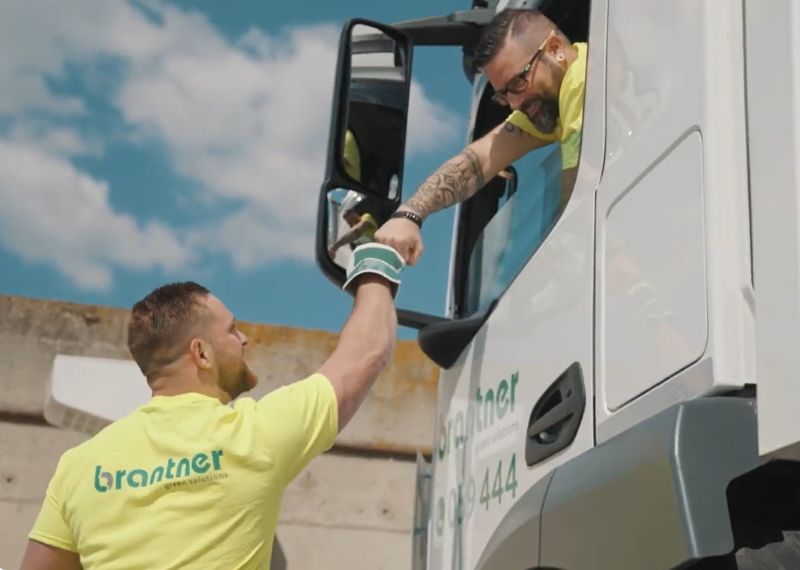
Brantner green solutions has been in the market for ninety years, since 1936, and is headquartered in Krems in Lower Austria. The company has built a network of 65 facilities and branches across Austria, Slovakia, the Czech Republic, Romania and Serbia, employs roughly 2,500 people and serves more than 28,000 municipal, industrial and commercial customers. The annual revenue of the activities involved exceeds EUR 320 million.
The portfolio runs from waste collection through sorting and recycling to resource recovery, covering the same integrated value chain that forms the backbone of Paprec’s own business model. This structural similarity explains why the French group chose this company as its entry point: it is not buying a single technological competence but a functioning network spanning five countries, complete with a portfolio of municipal contracts.
What Does the Paprec Brantner Acquisition Mean for the Region’s Waste Market?
The most important message of the Paprec Brantner acquisition is not the size of the transaction but its direction. The major players of the Western European waste industry — Veolia, Suez, Remondis, FCC and PreZero among them — have gradually saturated their home markets in recent years and increasingly look for further growth in the eastern member states. Paprec had stayed out of that race so far: after France it strengthened its position in Switzerland, then in Spain and Italy, but had no presence at all in Central and Eastern Europe. With this move it enters five national markets at once, and immediately at significant scale.
Two factors give the region its appeal. One is regulatory pressure from the European Union: the new regulation on packaging waste, the restructuring of extended producer responsibility schemes and the obligations to reduce landfill rates all generate enormous investment needs in sorting and recycling capacity. The other is catch-up potential: while Austria sits among the EU’s leaders in recovery rates, Slovakia, the Czech Republic, Romania and Serbia lag well behind, meaning the coming decade will see the construction of infrastructure that Western Europe has already built. The Paprec Brantner acquisition plays precisely on that gap.
Paprec’s Road From La Courneuve to EUR 4.5 Billion in Revenue
The French group’s story began thirty-two years ago as a small waste paper recycling company in La Courneuve near Paris, with forty employees. Today Paprec is one of Europe’s leading circular economy companies, operating across the entire waste management value chain. The first stop of its international expansion, more than fifteen years ago, was Switzerland, followed by Spain, where it now employs nearly four thousand people, and then Italy.
Once the transaction closes, Paprec Group will employ approximately 26,000 people in fifteen countries across some 450 sites, with annual revenue exceeding EUR 4.5 billion. Mathieu Petithuguenin, chairman and chief executive officer of the group, called the agreement a milestone in the company’s history and referred to it as the most significant acquisition since the 2016 Coved merger. The logic he set out is that Paprec brings into the region the technologies and expertise it has developed over the past three decades, while preserving the entrepreneurial culture that made Brantner green solutions successful.
Consolidation From Above, Catch-Up From Below
The Paprec Brantner acquisition visibly fits a process in which the European waste industry is reorganising around a handful of groups operating at continental scale. Size is becoming ever more of a competitive advantage in this sector: the automation of sorting plants, chemical recycling projects, the digitalisation of separate collection and quality assurance for secondary raw materials are all investments that need large volumes and a long tolerance for payback.
The question the coming years will answer is how far this concentration means genuine technological catch-up for the region, and how far it amounts to nothing more than a change of ownership over existing assets. In Brantner’s case the continued presence of the family as a minority shareholder and the continuity of management at least suggest that the parties have set themselves up for continuity rather than rapid restructuring. Once the transaction closes, expected in the fourth quarter of 2026, it will become clear whether the investment programme promised in the announcement genuinely materialises in the treatment capacity of the five countries concerned.
FAQ
When was the Paprec Brantner acquisition announced?
The announcement was published on 11 August 2026 in Paris and in Krems, Austria. Paprec Group stated that it had signed an agreement to acquire a majority stake in Brantner green solutions. Completion of the transaction depends on the required regulatory approvals, and the parties expect it in the fourth quarter of 2026.
What percentage of Brantner green solutions is Paprec buying?
Paprec is acquiring an 80 percent stake, while the remaining 20 percent stays with the Brantner family. The arrangement is therefore not a full buyout but a strategic partnership: through its minority holding the family remains involved in governance, and Bernd Brantner takes the vice chairman position in the new entity.
In which countries does Brantner green solutions operate?
The company is present in five countries: Austria, Slovakia, the Czech Republic, Romania and Serbia. Its headquarters are in Krems in Lower Austria. The network consists of 65 facilities and branches, employs roughly 2,500 people and serves more than 28,000 municipal, industrial and commercial customers.
How large is the revenue of Brantner green solutions?
The annual revenue of the activities covered by the transaction exceeds EUR 320 million. No purchase price was disclosed. For Paprec this is the largest investment since the 2016 Coved merger, taking the group into five markets at once where it previously had no operating presence at all.
Does the agreement cover the entire Brantner Group?
No, the agreement relates exclusively to Brantner green solutions, the environmental and waste management arm of the group. Brantner logistic solutions and Brantner Real Estate remain entirely family-owned, and according to the announcement they will continue to be developed independently in the future.
How big will Paprec be after the transaction?
Once the deal closes, Paprec Group will employ approximately 26,000 people in fifteen countries across some 450 sites. Annual revenue is expected to exceed EUR 4.5 billion. The group started 32 years ago as a forty-person waste paper recycling company in La Courneuve near Paris.
Source:
