


If you like our site, mark us as a preferred source on Google — so you’ll see our articles more often in search!
★Mark us as a preferred sourceThrough conscious waste sorting and a well-developed infrastructure, over 15,000 tons of packaging waste were collected in the Austrian capital in 2025. Thanks to the joint efforts of ARA and the Vienna Sanitation Department (MA 48), the volume of yellow bin and yellow bag collections increased by 14 percent, further strengthening Vienna’s leading role in building a circular economy and conserving raw materials.
Over 15,000 Tons of Collected Plastic and Metal Packaging
During 2025, the Viennese population achieved outstanding results in selective waste collection. A total of more than 15,000 tons of packaging material ended up in the yellow bins and yellow bags, representing a 14 percent volume increase—a so-called “Sammelplus”—compared to the previous period. Proper sorting of packaging materials is a fundamental condition for keeping valuable raw materials in the economic and industrial loop, allowing them to be recycled as secondary raw materials. The 14 percent surplus clearly proves that the Viennese are increasingly taking active steps to promote the circular economy (Kreislaufwirtschaft), resource conservation, and Austria’s raw material security.
Pillars of Success: Continuous Education and Targeted Campaigns
One of the most important factors behind these outstanding results is the continuous awareness and educational work carried out jointly by ARA (Altstoff Recycling Austria AG) and MA 48. Both partners operate extensive information programs. ARA seeks to reach the public through out-of-home campaigns like “Jeder Wurf zählt” (Every Throw Counts), alongside a strong social media presence and special attention to educating younger generations through programs like ARA4kids or Kinderuni on Tour.
In parallel, Vienna’s Department 48 (MA 48) has launched practical and easily accessible initiatives. Examples include the “Tu was für den Kreislauf” (Do Something for the Loop) campaign, and the traditional annual Mistfest (Trash Festival), both of which make the importance of waste recycling tangible. The 48er-Pocket-Trenninfo, a pocket guide on proper waste sorting available in 18 languages, deserves special mention. In addition, the organization’s waste consultants begin educating children in kindergartens and schools, and also assist the adult population as direct contacts.
Harald Hauke, spokesperson for the ARA board, explained the results: “The 14 percent more waste in the yellow bin is not by chance, but the well-thought-out interplay of infrastructure, information, and the commitment of the Viennese. Vienna impressively proves that the circular economy works in everyday urban life when everyone pulls in the same direction. Every properly sorted packaging provides valuable raw materials for the recycling loop and reduces the need for natural resources. Waste sorting is just a small everyday gesture that has a massive impact on the environment and the economy.”
Expanded Infrastructure: All Plastics in the Yellow Bin Since 2023
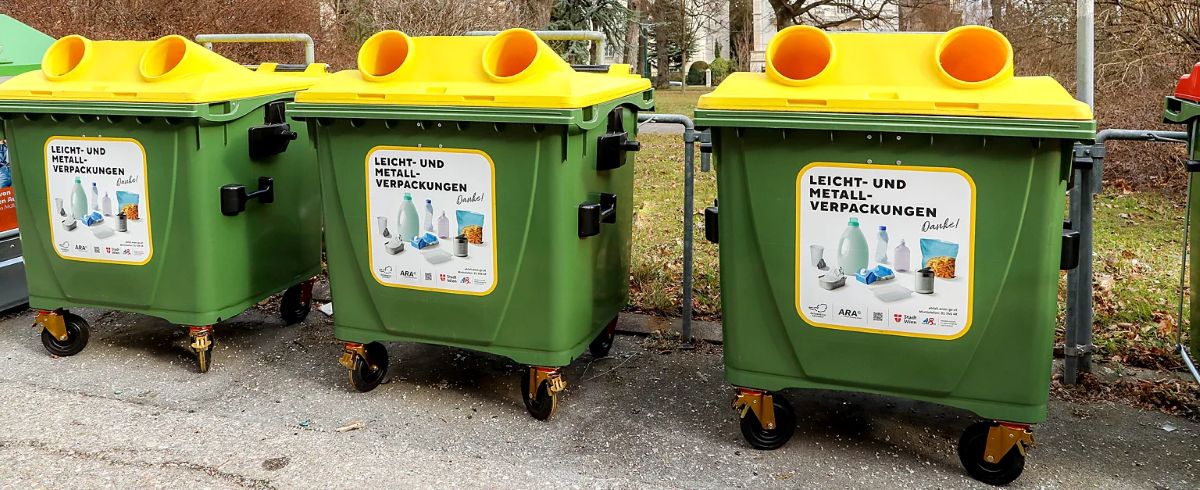
A significant milestone in the history of Vienna’s waste management was the expansion of the collection system in 2023. Since then, plastic packaging has been collected together with metal packaging in the yellow bins and yellow bags. The simplified, easily memorable, and accessible system significantly makes things easier for residents and fundamentally contributes to positive waste management behavior.
Today, more than 20,000 yellow bins are available to the public in the capital. These containers are located directly in the waste storage rooms of residential buildings or at 4,400 public selective collection islands established across the city. The infrastructure network is complemented by yellow bag collection, which covers about 46,000 households in detached houses, thereby ensuring complete, city-wide coverage for the selective collection of plastic and metal packaging.
Josef Thon, head of the MA 48 department, emphasized the role of the public: “Proper waste sorting, and thereby protecting our environment, is not a difficult task at all. The Viennese prove this every day. Every year we collect well over 15,000 tons of plastic and metal packaging, which is another important step towards a Zero Waste, or waste-free city. Selective collection is implemented climate protection itself. Together with ARA, we continue to focus on public education, as we still need their support. A huge thank you to every Viennese for their efforts so far. Bauts kan Mist! (Keep it clean!)”
92 Percent of the Population Satisfied with the System
The social support for the new system and the expanded selective collection is also backed up by a recent study from late 2025. Commissioned by ARA, the IMAS market research institute conducted a representative survey between October 6 and November 7, 2025, using computer-assisted telephone interviews. The research results showed that 92 percent of the Viennese rate the concept of selective packaging collection as “very good” or “good”.
With this result, Vienna surpasses the Austrian national average of 91 percent. The survey also revealed that nearly a third of the respondents would like to sort even more waste and even more accurately in the future—an indicator that also exceeds the national average. These data clearly prove that in a European comparison, Vienna remains a frontrunner in selective waste collection in an urban environment.
Original Reference and Source: ARA and MA 48: 14 Prozent Sammelplus in der Gelben Tonne zeigt Erfolg von Infrastruktur und Bewusstseinsbildung


