




If you like our site, mark us as a preferred source on Google — so you’ll see our articles more often in search!
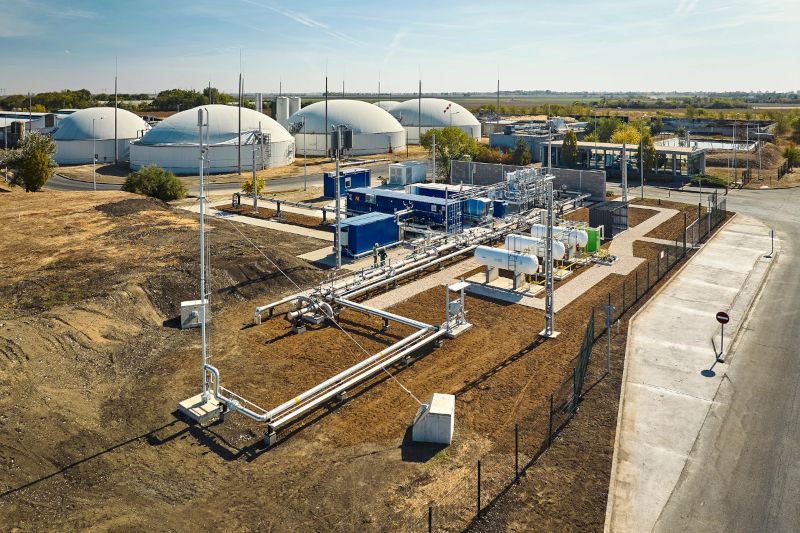
★Mark us as a preferred sourceThe Szarvas biomethane plant is up and running: on 14 October 2026, MOL inaugurated its first own biomethane production unit in Szarvas, Békés County, in south-eastern Hungary. Thanks to an investment of more than HUF 2.7 billion, biogas produced at the Szarvas Biogas Plant – in operation since 2011 – can now be upgraded to a purity that allows it to be injected directly into the national natural gas grid. Here is a plain-language look at what lies behind the announcement: where the feedstock comes from, how biogas becomes biomethane, how big the volume really is, and why the climate balance of this “green gas” is not simple arithmetic.
In short: The Szarvas biomethane plant replaces more than 7 million cubic metres of fossil natural gas in the grid each year, roughly the annual gas demand of 8,500 average households. Its feedstock is meat-industry waste, manure and agricultural by-products, and its technology strips carbon dioxide and impurities out of the biogas. It is MOL Group’s first such facility and only the third in Hungary.
What happened in Szarvas?
Back in May, MOL announced that it would add a biomethane unit to the Szarvas site it had acquired in 2023 – at the time, we covered the investment plans in detail. Originally promised for the end of 2026, the project was completed in mid-October. At the inauguration the system was still in its test phase, with continuous production scheduled to begin in October.
The key facts at a glance:
- Investment: more than HUF 2.7 billion.
- Capacity: over 7 million cubic metres a year of grid-quality biomethane.
- Technology: the upgrading unit was supplied by Italy’s Gruppo AB.
- Operator: Aufwind Schmack Első Biogáz Szolgáltató, part of MOL Group.
- Certification: the product carries an ISCC green certificate, making it a far higher value product than fossil gas.
- Strategic framework: the project is part of MOL’s long-term SHAPE TOMORROW strategy.
Speaking at the inauguration, György Bacsa, Managing Director of MOL Hungary, said the project serves both energy security and the expansion of the company’s sustainable product portfolio, and that in the longer term MOL aims to turn biomethane into a large-scale, tradeable gas business.
Biogas or biomethane – what’s the difference?
The two terms are often used interchangeably, yet the difference is the very point of the Szarvas project.
Biogas forms when organic matter – crop residues, manure, food and meat-processing waste – breaks down without oxygen. Its main component is methane, but it also contains a substantial share of carbon dioxide, sulphur compounds and other substances. In this form it cannot be fed into the gas grid, so in Szarvas it has so far been burned on site in gas engines to produce electricity and heat.
Biomethane is the same gas, cleaned up: in composition and calorific value it is practically equivalent to pipeline natural gas. That is why it can be injected into the grid, and compressed (bioCNG) or liquefied (bioLNG) it can also fuel buses and lorries.
A simple analogy: biogas is the raw material, biomethane is the finished product. What Szarvas has built is the “refinery” between the two.
How does the Szarvas biomethane plant work?
The process breaks down into four distinct steps.
1. Feedstock: the region’s leftovers
Each year the plant processes more than 40,000 tonnes of waste from the region’s meat production, plus some 53,000 tonnes of slurry and turkey manure from neighbouring livestock and meat-processing farms, and around 18,000 tonnes of agricultural substrate. According to an on-site report by Telex, more than twenty different materials go into the mix – from corn husks and residual cooking oils to whey from a local mozzarella factory – while pig slurry arrives through an underground pipe from the neighbouring pig farm. Because the available feedstock changes over time, a biologist helps fine-tune the recipe.
2. Fermentation: slow, controlled decomposition
The mix is fed into four digester tanks, where it ferments at over 40 °C for 40 to 50 days. Roughly 300 tonnes of fresh material go in and the same amount comes out every day, keeping the bacterial culture that does the work continuously alive. Biogas collects under the domes of the tanks at a rate of around 1,500 cubic metres per hour. The residue then passes through three post-digesters to recover the remaining methane.
3. Upgrading: the job of the new unit
This is the heart of the investment. The incoming biogas first passes through three activated carbon tanks that capture sulphur and other contaminants. The gas is then cooled and pushed through membranes at high pressure; these hold back the carbon dioxide and let the methane through. The finished gas is checked by measuring instruments and odorised – just like natural gas, so that any leak can be smelled – and if its calorific value falls short of grid specifications, it is topped up with propane.
4. What’s left: fertiliser for the fields
The residue after fermentation is not waste either. The solid fraction goes to an organic fertiliser line, while the liquid fraction is stored in lagoons and spread on local fields before sowing and after harvest. Nutrients thus return to the land that grew the feed and crops in the first place.
How much gas is it really?
Seven million cubic metres is a tangible amount: it covers the total annual gas demand of about 8,500 average Hungarian households. Still, proportions matter.
- Compared with national gas consumption, this is in the range of a tenth of a percent, since Hungary’s annual natural gas demand is measured in billions of cubic metres.
- Compared with sector targets, it is more significant: according to an industry survey presented by Hungary’s Institute of Agricultural Economics, 255 million cubic metres of domestic biomethane production per year is a realistic goal for 2030. Szarvas alone would deliver about 3 percent of that.
- Within Hungary, Szarvas is only the third biomethane plant feeding the grid. The other two, Pannonia Bio in Dunaföldvár and Magyar Cukor in Kaposvár, largely rely on by-products from their own production. According to the operator, Szarvas is the first to produce biomethane entirely from feedstock bought in from farmers and manufacturers.
In other words, the Szarvas biomethane plant will not rewrite Hungary’s energy balance on its own, but it offers a working model: an existing biogas plant can become “grid-ready” with a relatively unspectacular intervention.
The price of green power: the same biogas can’t be used twice
One important detail is easily lost in the inauguration headlines. Until now, the site’s biogas was burned in gas engines, producing around 24 GWh of renewable electricity and significant amounts of heat each year – some of which went to a nearby poultry processor. But the volume of biogas is finite: whatever is upgraded to biomethane and fed into the grid can no longer drive the engines.
Evelin Halász, managing director of the operating company, told Telex that the gas engines are still needed and will keep running, but from now on they will mostly generate electricity from fossil natural gas. Switching between the two modes takes about an hour, so depending on market demand, the biogas can be diverted back to power generation.
What does this mean in practice? The climate effect is not simple addition: biomethane displaces 7 million cubic metres of fossil gas in the grid, but on site some of the formerly green electricity is now made from fossil gas. The net benefit depends on where the biomethane ends up. If it replaces diesel or fossil CNG in transport – where certified renewable gas is most valuable – the swap can be favourable. It also makes business sense, as ISCC-certified biomethane is worth more than locally sold green electricity. This balance will be worth tracking with hard numbers in the coming years.
Through a waste management lens: feedstock is the bottleneck
The biggest risk for a biogas plant is not the technology but a stable supply of good-quality feedstock. It is no coincidence that MOL’s announcement stresses long-term cooperation with its agricultural partners.
From a waste perspective, three lessons stand out:
- A lot of organic material still ends up in the wrong place. A recent Czech survey found that 40 percent of mixed municipal waste is biodegradable – material that causes methane emissions in a landfill but could provide energy in a biogas plant.
- The waste hierarchy applies here too. Food that is still edible does not belong in a digester: a Danish study showed that supermarkets are financially better off donating surplus food than sending it off as biogas feedstock. Biogas is for the leftovers that can no longer be used for human consumption.
- What’s new is where the gas goes. Biogas itself is nothing new in Hungary; the novelty is that instead of being burned on site, the gas is now sent into the grid and into transport.
What comes next?
Ádám Horváth, MOL Group’s director of new and sustainable businesses, told Telex that the company is open to further biogas and biomethane plants in Hungary and the region, but has no concrete targets yet. MOL would buy most of the biomethane it needs from other producers; its own plants – acquired or built greenfield – would mainly serve to reduce risk and deepen its understanding of the value chain. The company intends to use the experience gained in Szarvas specifically for these decisions.
The main driver is transport. Under EU rules, by 2030 transport must reach at least a 29 percent renewable share or a 14.5 percent reduction in greenhouse gas intensity, and certified biomethane injected into the grid can be an important tool for getting there. A CNG bus presented at the inauguration is set to run on a scheduled Budapest route using biomethane supplied by MOL.
Whether the Szarvas model spreads depends, by stakeholders’ broad agreement, on a predictable support scheme, a clear legal framework and lasting cooperation between the agricultural and energy sectors. The question for the coming years is therefore not whether the technology works – in Szarvas it does – but whether there will be enough plants, feedstock and buyers to turn biomethane from a rounding error into a meaningful energy source.
FAQ – Szarvas biomethane plant
When was the Szarvas biomethane plant inaugurated?
The Szarvas biomethane plant was inaugurated on 14 October 2026 in Szarvas, Békés County, Hungary. MOL acquired the Szarvas Biogas Plant, operating since 2011, in 2023 and added a biomethane production unit at a cost of more than HUF 2.7 billion. At the inauguration the system was still in its test phase, with continuous production scheduled to start in October.
How much biomethane does the Szarvas biomethane plant produce each year?
The plant can feed more than 7 million cubic metres of biomethane into the grid each year, replacing the same amount of fossil natural gas. That equals the annual gas demand of roughly 8,500 average Hungarian households. Previously, the site’s 11–12 million cubic metres of biogas a year were burned in gas engines, producing about 24 GWh of green electricity plus heat.
What is the difference between biogas and biomethane?
Biomethane is upgraded biogas that is practically equivalent to pipeline natural gas. Raw biogas contains methane but also large amounts of carbon dioxide, sulphur compounds and other substances, so it cannot be injected into the grid directly. In Szarvas, the gas goes through activated carbon filtering, membrane CO2 separation, quality checks and odorisation before entering the network.
What waste is used to make biomethane in Szarvas?
Biomethane in Szarvas is made mainly from organic material from livestock farming and the food industry. Each year the plant processes over 40,000 tonnes of meat-industry waste, around 53,000 tonnes of slurry and turkey manure, and about 18,000 tonnes of agricultural substrate. More than twenty materials are used in total, including corn husks and whey from a local cheese factory.
How many biomethane plants are there in Hungary?
Szarvas is only the third facility in Hungary producing biomethane that can be injected into the gas grid. The other two are Pannonia Bio in Dunaföldvár and Magyar Cukor in Kaposvár, which largely use by-products from their own production. According to the operator, Szarvas is the first to make biomethane entirely from feedstock bought in from farmers and manufacturers.
Does the Szarvas biomethane plant fully replace fossil gas?
Not entirely, because the same biogas can only be used once. According to the operator, the site’s gas engines keep running, but they will now mostly generate electricity from fossil natural gas, since the biogas goes into the grid as biomethane. Switching between the two modes takes about an hour, so use can follow market demand.
🔗 Official sources and references: 👉
- MOL Media Room – MOL’s first biomethane plant inaugurated in Szarvas (official press release, in Hungarian)
- Telex – MOL makes grid-ready methane from manure and corn husks (in Hungarian)
- Newjság – MOL’s first biomethane plant inaugurated (in Hungarian)
- behir.hu – Clean energy from waste: MOL Group’s biomethane plant opens in Szarvas (in Hungarian)
- Institute of Agricultural Economics (AKI) – biomethane conference summary (in Hungarian)
Consistent structure, quick answers: every article is built so that both readers and AI search tools can find the key points easily. Our content is produced with the help of AI tools and reviewed by our editor.
