
'/%3E%3C/svg%3E)



If you like our site, mark us as a preferred source on Google — so you’ll see our articles more often in search!
★Mark us as a preferred sourceWar waste is one of the hardest categories in waste management. It combines the sheer volume of construction and demolition debris with an unpredictable mix of hazardous substances, biological contamination and the risk of unexploded ordnance — all in a situation where the very technical infrastructure needed to handle it has been destroyed. The waste volumes generated in the Gaza Strip and their environmental impact have become a textbook illustration of what the profession has argued for decades: waste and wastewater do not recognise administrative boundaries.
The analysis below deals exclusively with the waste management and environmental dimensions of the problem.
The three critical fractions of war waste
From a technical standpoint, conflict-generated waste separates into three streams that require sharply different handling logic.
The first is untreated municipal wastewater. It is not “waste” in the classical sense, but it is the most immediate and fastest-spreading consequence of a collapsed waste and sanitation system.
The second is contaminated demolition debris — an enormous, largely inert waste body shot through with hazardous and biological fractions. Without characterisation, no responsible treatment decision can be made about it.
The third is the hidden hazardous content: asbestos, heavy metals, industrial chemicals, munitions residues. This fraction cannot be collected separately, because it is dispersed throughout the entire mass of the debris. That is what makes war waste qualitatively different from earthquake debris or ordinary demolition waste.
When wastewater treatment collapses
Wastewater treatment does not work without power. When energy supply and sanitation infrastructure are damaged simultaneously, the system does not slow down — it stops. Sewage then reaches the receiving water body or the ground immediately and at full volume. According to the analysis referenced here, in the Gaza Strip this means more than 100,000 cubic metres of untreated sewage discharged into the Mediterranean or onto land every day.
The behaviour of this waste stream is hydrologically predictable. Currents in this part of the Mediterranean run predominantly from south to north, so the contaminated water column migrates along the coastline. The consequences are no longer theoretical: the Ashkelon desalination plant on the southern Israeli coast has had to shut down repeatedly because of high faecal bacterial contamination. Raw sewage also triggers algal blooms that load and damage the membrane filtration systems of desalination plants, and it creates oxygen-depleted dead zones on the seabed where fishing becomes impossible.
The food chain is the next station. Pathogens, heavy metals and toxins entering with the wastewater are taken up by marine life, and fish do not respect maritime boundaries. Contaminated seafood therefore presents the same public health risk to consumers on both sides of the coastline.
This is the point at which wastewater treatment stops being a local service question: the impact of one decommissioned treatment plant relocates tens of kilometres away, into a different water management jurisdiction.
Sixty million tonnes of rubble: an extreme case of demolition waste
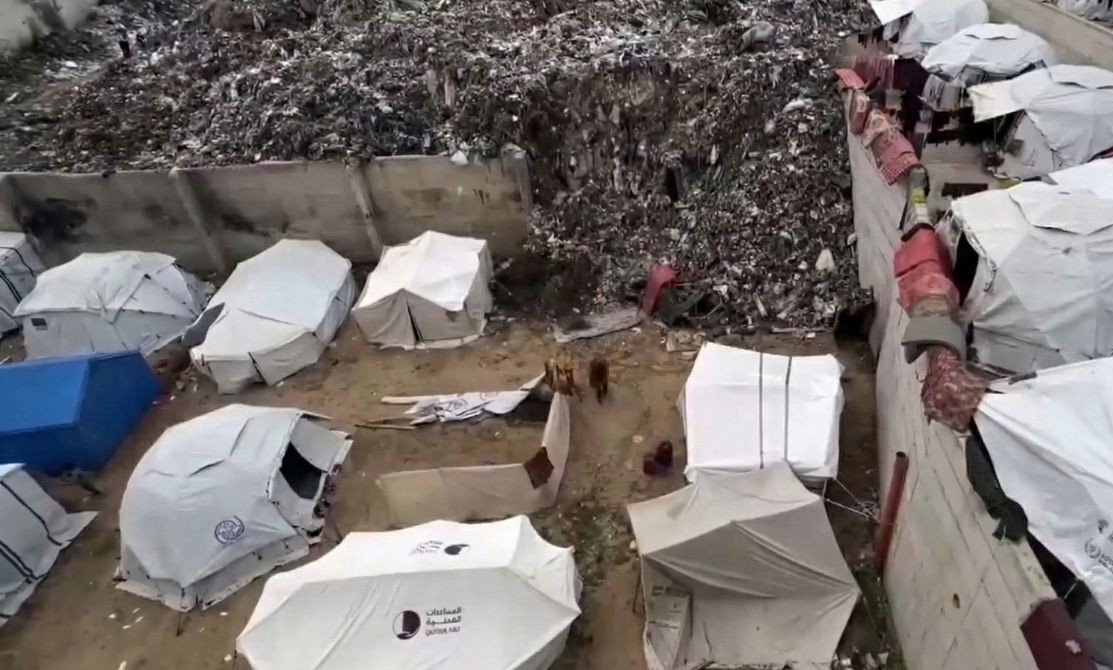
The estimated volume of debris is 60 million tonnes. For comparison, that is roughly the amount of construction and demolition waste a mid-sized European country generates over several decades — except here it sits in a single area of a few hundred square kilometres, unsorted, with no treatment infrastructure available.
The composition is what creates the technical problem. According to the referenced analysis, contaminants include lead, mercury, cadmium and traces of other metals, residues from specialised munitions, white phosphorus particulates, unspent explosives, industrial chemicals, and widespread asbestos fibres released from pulverised older buildings. Heavy metals present in dust and rubble may be carcinogenic, mutagenic, teratogenic, neurotoxic and nephrotoxic, and may bioaccumulate — meaning the risk is not limited to the handling period but persists in the environmental matrix for the long term.
To this is added the biological fraction: decomposing organic matter, body fluids, human remains, accumulated household waste, and the insect and rodent vectors that follow. Airborne contamination — asbestos fibres and fine particulate matter — degrades air quality, while unexploded ordnance embedded in the debris creates both a detonation hazard and localised soil toxicity.
Handling a waste body like this is technically not “removal”. It requires characterisation, selective dismantling, asbestos abatement, explosive ordnance disposal screening, separation by risk class, and controlled recycling of the inert fraction — in that order.
The logic of transboundary waste flows
Part of the debris has reportedly been moved out of the strip: Euro-Med Monitor tracked roughly 100 trucks leaving daily in recent weeks, with disposal or storage sites undisclosed. From a waste management perspective, this movement is itself a decision point: contaminated material is not destroyed by transport. It is relocated, contaminant load included, to a new site.
The shared aquifer question is more complex still. Coastal aquifers do not follow political borders. Pathogen migration in groundwater is typically limited — the referenced analysis also considers it unlikely that pathogen-contaminated groundwater would feed directly into municipal water supplies — but salts and dissolved chemical contaminants travel considerably farther and represent the larger long-term risk to the aquifer. They reduce the quality and usability of groundwater for irrigation, agriculture and drinking water alike.
In other words, the waste risk runs on two different timescales: microbiological contamination is a public health event measured in days and weeks, while chemical and salt contamination is decades-long degradation of the water resource.
What disaster debris protocols require
Established international procedures exist for moving heavily contaminated disaster debris. The UN Environment Programme (UNEP) and regional technical bodies — such as the Gaza Debris Management Working Group (DMWG) — prescribe strict protocols for isolating hazards. These include an immediate freeze on operations if human remains are detected, along with requirements to segregate contaminants and control transport routes.
When material crosses an administrative or jurisdictional boundary, additional legal frameworks and rigorous groundwater protection standards apply. This is a general waste management principle: transboundary movement of hazardous waste requires notification, tracking and guarantees of treatment on the receiving side, and responsibility is not discharged by transport. According to the analysis, a significant share of the debris transfers took place without regard to these rules, which primarily increases exposure for people living near collection and disposal sites and for the personnel handling the material.
It is worth noting that the technical warning is not new. Regional environmental organisations, including EcoPeace, have argued for years that a shared water resource and marine environment create complete interdependence — meaning a sanitation crisis at any point in the system is a public health risk for the whole system. The same recognition is reflected in the working group on sanitation and public health announced in early August, whose membership and operating structure have not yet been made public.
What the waste management profession can take from this
The case offers several conclusions that apply to any disaster or crisis situation.
The energy dependence of wastewater treatment is a systemic vulnerability. Without backup power and a fallback operating mode, sanitation does not slow down — it ceases. That is a planning question, not an operational detail.
A debris management plan is not written after the disaster. Characterisation methodology, designated temporary storage sites, asbestos and ordnance handling protocols and measurement chains can all be prepared in advance. Done retroactively, the same work takes years instead of weeks.
“Removal” is not treatment. Without characterisation and risk classification, moving material only relocates the contamination and creates risk at a new, often less protected, site.
Monitoring is the highest-return investment. Without seawater, groundwater and air quality monitoring networks, contamination cannot be tracked and intervention is necessarily late. The Ashkelon shutdowns show that the measurement system works — but by then, intervention at the source is no longer possible.
Waste behaves at system level. The effect of a collapsed treatment plant appears in neighbouring water resources within weeks, and the marine food chain carries the contamination back to consumers on both sides of the coastline. This is the fundamental characteristic of waste management: the absence of treatment cannot be localised.

Frequently asked questions about war waste
Why is war waste a special waste category?
War waste combines three streams at once: high-volume demolition debris, dispersed hazardous substances and biological contamination, with the added risk of unexploded ordnance. The hazardous fraction cannot be collected separately because it is scattered throughout the entire mass. That is what makes handling it technically far more complex than earthquake debris.
How much untreated sewage enters the environment?
According to the referenced analysis, more than 100,000 cubic metres of untreated sewage reaches the Mediterranean or the ground every day, because simultaneous damage to power supply and sanitation infrastructure halted wastewater treatment. Currents in this part of the Mediterranean run south to north, so the contaminated water column migrates along the coast and reaches southern Israeli waters.
What hazardous substances are found in war debris?
Lead, mercury, cadmium and traces of other metals, residues from specialised munitions, white phosphorus particulates, unspent explosives, industrial chemicals, and asbestos fibres released from pulverised older buildings. A biological fraction is present too: decomposing organic matter, body fluids and human remains. Heavy metals may bioaccumulate, so the risk persists after handling ends.
Why is removing the debris not enough?
Because transport does not destroy contaminants — it relocates them to a new site, often under less protected conditions. Responsible treatment is only possible after characterisation, risk classification, asbestos abatement and ordnance screening. When material crosses a border, notification, tracking and groundwater protection requirements also apply, and responsibility is not discharged by transport.
How does contamination spread through a shared aquifer?
On two separate timescales. Pathogen migration in groundwater is typically limited, and entry into municipal water supplies is considered unlikely. Salts and dissolved chemical contaminants, however, travel much farther and degrade the quality and usability of the aquifer over decades — for drinking water, irrigation and agriculture alike.
The data in this article draws on an opinion piece by Dr Dianne Woodward published in Al Jazeera’s opinion section on 30 August 2026, and on the organisations referenced there (UNEP, DMWG, Euro-Med Monitor, EcoPeace). Our analysis addresses only the waste management and environmental aspects of the topic; the political assessment of the conflict is not the subject of this article. Source: aljazeera.com
Consistent structure, quick answers: every article is built so that both readers and AI search tools can find the key points easily. Our content is produced with the help of AI tools and reviewed by our editor.
