




If you like our site, mark us as a preferred source on Google — so you’ll see our articles more often in search!
★Mark us as a preferred sourceOn 29 October 2026 RaboResearch, the research arm of Rabobank, published an analysis of whether bringing waste incineration into the EU Emissions Trading System (EU ETS) could unlock carbon capture, utilisation and storage (CCUS). Waste-to-energy CCUS is one of the few credible decarbonisation routes for the sector – the open question is when, where and under what conditions it pays off. The analysis, written by Boglárka (Bogi) Márkus, the bank’s energy transition specialist, reaches a sober conclusion: a carbon price improves the numbers, but on its own it does not close the gap.
In short: Waste-to-energy CCUS only breaks even under the EU ETS at very high carbon prices: Rabobank’s model shows that with a 45% fossil share and a full-chain cost of €190 per tonne, the allowance price would need to reach about €422. Deployment will therefore also depend on transport and storage infrastructure, public risk-sharing and credible carbon-removal revenue.
What did Rabobank examine, and why now?
In July 2026 the European Commission proposed a revision of the EU ETS that would gradually bring non-hazardous waste incineration installations into the system from 2031, with full coverage from 2034. We covered the proposal and the critical responses from CEWEP, ITAD and BDSAV in our earlier analysis.
Rabobank starts from one figure: municipal waste incineration in the EU emits roughly 40 million tonnes of fossil CO₂ equivalent a year, and in most Member States these emissions are not currently subject to dedicated decarbonisation policy. ETS coverage would turn the fossil carbon content of residual waste into a direct financial liability. Operators would no longer only have to treat waste reliably and recover energy from it; they would also have to manage a growing carbon-cost exposure.
Europe’s incinerators: 499 plants, very unevenly spread
According to CEWEP, around 499 waste-to-energy plants operate in Europe, thermally treating more than 101 million tonnes of residual waste a year while generating electricity and heat. Capacity is highly concentrated:
- Germany, France and the UK account for more than half of Europe’s facilities and nearly 56 million tonnes of annual capacity.
- Germany treats almost 26 million tonnes a year in 92 plants, giving it a large average plant size.
- The Netherlands runs one of Europe’s most concentrated systems: 12 facilities treat about 7.4 million tonnes, more than 600,000 tonnes per plant.
Central and eastern European countries – Poland, Czechia, Slovakia, Hungary and Romania – have relatively small incineration fleets and rely more heavily on landfill. Rabobank sees potential for growth there, but with caution: incineration is generally more expensive than landfilling and needs predictable waste streams to keep plants well utilised. According to Eurostat, around 50 million tonnes of municipal waste are still landfilled in the EU every year. As landfill restrictions and methane targets tighten, part of this stream could shift towards material recovery and thermal treatment, so new-build plants are most relevant in southern and eastern Europe, while mature markets will focus on modernisation.
Why carbon capture is one of the few real options
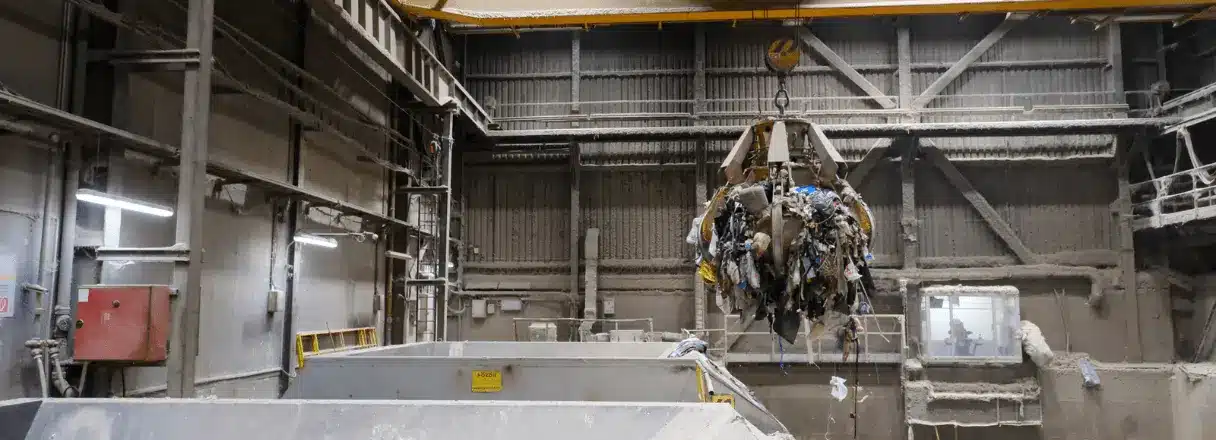
A waste-to-energy plant works in a familiar way: mixed residual waste is burned at high temperature, the heat raises steam, the steam drives a turbine, and the remaining heat often goes into district heating. Flue gas leaves the stack after multi-stage cleaning. The carbon in the waste ends up as CO₂ in the flue gas – making the plant a concentrated and, because it runs all year, relatively steady emission source, which suits carbon capture.
The decisive argument, however, is a different one. Many industries can cut emissions by switching fuels or electrifying; an incinerator cannot, because its emissions come from the carbon in the waste it receives. As long as Europe produces residual waste, incineration will produce CO₂. Capture is therefore a route that leaves the plant’s core function – treating waste and recovering energy – intact.
Yet a capture unit is not a simple bolt-on. It consumes heat and electricity, reducing the energy available for sale, and must be integrated with the steam cycle, flue-gas cleaning, district-heating obligations and the available space. Retrofitting an existing plant is more complex and costly than designing capture in from the start. Rabobank notes that projects are already operating in the Netherlands, Norway and the UK, and BloombergNEF’s database lists close to 20 planned CCUS projects in the waste-to-energy sector.
Fossil and biogenic carbon: a burden and an opportunity
Incinerator emissions have a mixed origin. Plastics and other fossil-based waste generate fossil CO₂, while food waste, paper, wood and other organic materials generate biogenic CO₂. This cuts both ways:
- A burden for near-term economics. The capture unit treats the entire flue-gas stream, but the obligation to surrender allowances – and therefore the saving – applies only to the fossil share. The lower the fossil share, the smaller the proportion of captured CO₂ that “earns” a saving, and the higher the allowance price needed to cover the same capture cost.
- An opportunity over the longer term. Permanently storing biogenic CO₂ may count as a carbon dioxide removal (CDR), so an incinerator could even become net-negative. That only becomes money, though, if the removals are credibly certified and there are buyers willing to pay.
Waste-to-energy is thus one of the few large point-source sectors where capture can address fossil and biogenic emissions at the same time.
Doing the maths: when does waste-to-energy CCUS pay off?
Rabobank built a simplified, assumption-based model with three scenarios: a plant without capture that buys allowances for its fossil emissions; a plant with capture that captures and stores at least 82% of its emissions; and the same plant earning additional revenue from removals generated by storing the biogenic fraction. The aim is not to predict the profitability of individual projects but to show how the business case shifts with the allowance price, costs, fossil share, capture rate and ETS coverage.
The logic is straightforward: each captured tonne of CO₂ reduces the allowance requirement only by its fossil share. With a 45% fossil share, one captured tonne is “worth” 0.45 tonnes of allowances. To break even, the allowance price must therefore reach the capture cost divided by 0.45. The bank’s results:
- With a full-chain cost of €190 per tonne (capture, energy, conditioning, transport, storage and monitoring), the break-even allowance price is about €422 per tonne.
- With a full-chain cost of €125 per tonne, it falls to roughly €278 per tonne.
A simple calculation of our own shows how far this is from today’s market. The allowance price hovered around €80 in summer 2026. At that price, a captured tonne with a 45% fossil share saves only €36 in allowance purchases, while the full chain costs €125–190. The gap is therefore roughly €90–155 per captured tonne.
One important detail: Rabobank assumes full ETS coverage. In reality, the Commission’s proposal includes a gradual phase-in and free allowances for plants supplying district heating until 2040 – and, according to Zero Waste Europe’s modelling, a high-heat plant could pay less than €6 per tonne of waste in real carbon cost in 2031. In the early 2030s the business case for capture could thus be even weaker than the bank’s model suggests.
Rabobank concludes that these break-even prices put waste-to-energy CCUS in a similar range to other hard-to-abate industrial applications. The ETS improves the economics of capture but does not, by itself, close the gap between the cost of capturing emissions and the cost of buying allowances.
Carbon-removal revenue: a conditional upside, not certain income
In the third scenario, selling removal units from stored biogenic CO₂ improves the picture – but the bank sees this as the most uncertain element, for several reasons:
- There is no liquid market. Permanent removals are not a standardised, exchange-traded product like allowances. Prices are usually negotiated in bilateral offtake agreements and depend on permanence, certification, delivery year, volume and project maturity.
- Published prices are not transaction prices. Benchmarks often reflect supplier offers, and buyer expectations can differ substantially.
- Certification is conditional and costly. The EU has adopted a certification methodology for carbon removals, but eligibility requires net quantification, deduction of lifecycle emissions, additionality, permanent storage, liability, sustainability safeguards and independent verification. Not every captured biogenic tonne becomes a saleable unit.
The UN Environment Programme’s report also warned that removals must come on top of emission cuts, not instead of them – and that capacity is limited. Accordingly, Rabobank treats removal revenue as a conditional upside rather than something as certain as avoided allowance costs.
According to the bank, a viable project is likely to need a combination of avoided allowance costs, falling capture costs, credible removal offtake agreements and appropriate risk-sharing. For the latter, it points to capital grants, shared transport and storage infrastructure, guarantees and carbon contracts for difference (CCfDs) – instruments that should complement removal revenue, not be confused with it.
Infrastructure and waste volumes: what decides beyond the numbers
In Rabobank’s view, the pace of deployment will not depend on the carbon price alone. Access to CO₂ transport and storage infrastructure is one of the biggest constraints, so feasibility may depend as much on geography as on plant-level economics. Equally important is the development of removal markets, which are still at an early stage and rest on evolving certification, accounting and demand frameworks.
The third uncertainty is the future volume of residual waste. Circular economy policy, recycling targets and prevention aim precisely at reducing the waste that needs treatment. Rabobank argues, however, that landfilled volumes in southern and eastern Europe, and the waste imports already taking place, suggest that in a more integrated European market, residual waste suitable for thermal treatment will remain available even under more ambitious circularity scenarios.
This argument is worth reading alongside the other side. A joint Zero Waste Europe–Reloop report estimates that more than 10 million tonnes of recyclable materials are lost in European incinerators every year, and ZWE estimates Europe already has around 60 million tonnes of excess incineration capacity. A capture investment with a 20–30-year payback needs a stable feedstock – which can sit uneasily with the waste hierarchy if it pulls the system towards incineration.
Who will pay the bill?
Rabobank’s system-level warning is perhaps the most important practical message. If neither capture nor other waste-sector abatement responds to the price signal, ETS costs will mainly raise waste-treatment fees. Incinerators provide a public service, often under contracts with municipalities and waste producers, so at least part of the extra cost will be passed on to municipalities, producers and ultimately households. How much is passed through depends on local market conditions, alternative treatment routes and public support, but the direction is clear: decarbonising residual waste treatment will not be cost-neutral.
What does this mean for Hungary?
Rabobank explicitly names Hungary among the countries with small incineration fleets and heavier reliance on landfill. The consequences here therefore look different from those in Germany or the Netherlands:
- Existing incinerators would enter the ETS from 2031. The Budapest Waste-to-Energy Plant also supplies district heating, so the proposed free allocation would initially soften the burden. The state-owned thermal plant in Polgár, which recovers energy from RDF and waste tyres, also falls within the scope of non-hazardous waste incineration.
- The RDF route is already affected. Cement plants co-incinerating refuse-derived fuel made from mixed waste are already covered by the ETS, so the fossil (plastic) content of RDF has long been a cost factor there.
- Capture is a long-term option for Hungary. To our knowledge, Hungary currently has no operational CO₂ transport network or commercial storage site, and the offshore storage hubs are far away. Rabobank’s point about geography applies with particular force here.
- The tangible near-term lever is the input. The less fossil plastic and synthetic textile ends up in residual waste and RDF, the smaller the future carbon bill. That depends on household separate collection, MOHU’s concession system and sorting efficiency.
Editorial assessment
The greatest strength of Rabobank’s analysis is its sobriety. It does not claim that the ETS will automatically usher in an era of carbon capture, nor that the removals market will solve everything. The picture is nuanced: the ETS is a necessary but not sufficient condition, and deployment will proceed at very different speeds across plants and regions.
From a central European perspective the lesson is twofold. First, waste-to-energy CCUS is not a 2031 question here but a much later one, because without infrastructure even the best model is worth little. Second, the cheapest and fastest climate gains in the waste sector still sit at the top of the hierarchy: cutting landfill and landfill methane, removing fossil-carbon-rich fractions from residual waste, and recycling. A carbon price rewards those steps too – provided the final rules leave a strong enough signal.
The proposal now goes to the European Parliament and the Council, so the final rules may still change.
Frequently asked questions: waste-to-energy CCUS
What is CCUS and why does it matter for waste-to-energy plants?
CCUS stands for carbon capture, utilisation and storage. Emissions from waste-to-energy plants come from the carbon contained in the waste itself, so they cannot be cut by switching fuels or electrifying. Rabobank therefore sees carbon capture as one of the few credible routes to decarbonise residual waste treatment while plants keep treating waste and recovering energy.
When will waste incinerators have to pay for their CO₂ emissions?
From 2031, on a phased basis, under the European Commission’s proposal. Non-hazardous waste incineration plants would first surrender allowances for part of their emissions, with full coverage from 2034. The obligation applies only to fossil CO₂. The proposal still needs the approval of the European Parliament and the Council, so the details may change.
What carbon price would make waste-to-energy CCUS pay off?
A very high one. Rabobank’s model shows that with a 45% fossil share and a full-chain cost of €190 per tonne, the allowance price would need to reach about €422; at €125 per tonne it would be roughly €278. That is several times the 2026 market level, so public support and carbon-removal revenue may also be needed.
Why does the mix of fossil and biogenic CO₂ matter?
Because the two affect the business case differently. A capture unit treats the entire flue-gas stream, but under the EU ETS only the fossil share saves allowance purchases. Permanently storing biogenic CO₂, however, may qualify as a carbon removal, which could earn extra revenue if certified and sold, and even make a plant net-negative.
What does EU ETS coverage of incineration mean for Hungary?
Mainly higher waste-treatment costs. Rabobank places Hungary among the countries with small incineration fleets and a heavier reliance on landfill. Existing incinerators would enter the ETS from 2031, but with no CO₂ transport and storage infrastructure in place, separating fossil plastics and textiles from residual waste is the most practical way to curb costs in the near term.
🔗 Official sources and references: 👉
- RaboResearch / Boglárka (Bogi) Márkus: EU ETS and Waste-to-Energy: Can carbon pricing unlock CCUS deployment? (Rabobank, 29 October 2026)
- European Commission: Proposal for the revision of the EU ETS, COM(2026) 616
- CEWEP: Waste-to-Energy plants in Europe – data and maps
- Eurostat: Municipal waste statistics
- European Union: Certification methodology for carbon removals
Consistent structure, quick answers: every article is built so that both readers and AI search tools can find the key points easily. Our content is produced with the help of AI tools and reviewed by our editor.
