




If you like our site, mark us as a preferred source on Google — so you’ll see our articles more often in search!
★Mark us as a preferred sourceAt the end of September, Tetra Pak Vietnam launched its Cartons for Communities programme (Vietnamese name: “Chung tay tái chế vỏ hộp giấy”, roughly “Joining hands to recycle cartons”). The aim is to make returning used milk and juice cartons simple, predictable and accessible for households, schools and shoppers alike – with a bilingual online platform at the heart of the system.
In short: Tetra Pak Vietnam’s new programme uses a bilingual website, a collection-point map and retail and school partnerships to make carton drop-off easier. From December 2026, existing collection activities will move to a community-based model built on designated residential collection points and scheduled pick-ups, backed by Vietnam’s extended producer responsibility (EPR) rules and its national circular economy action plan.
What does the new platform offer?
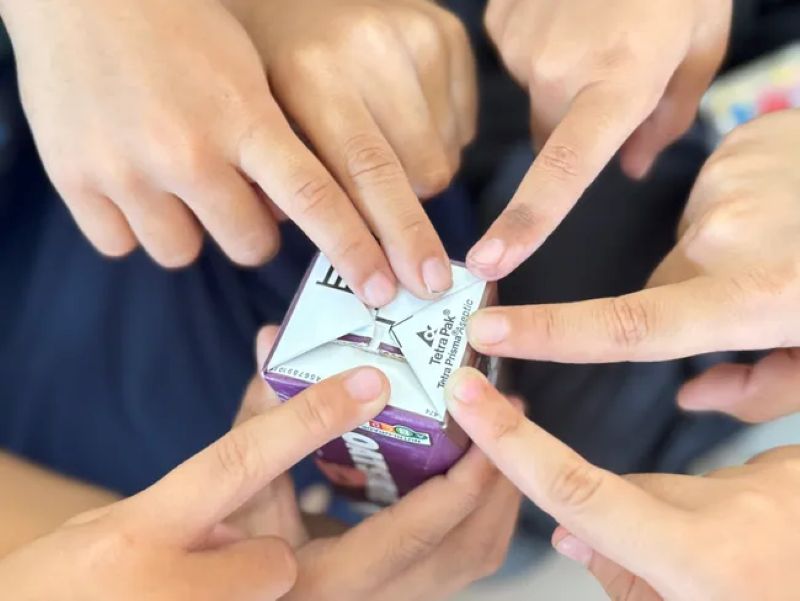
The programme’s centrepiece is a Vietnamese–English website that brings together everything residents and business partners need. Users can locate their nearest collection point on a map and get a short guide on preparing cartons in three steps: rinse, flatten, drop in the bin.
The platform is not only aimed at consumers. It also provides information for organisations and businesses that want to join the collection and recycling network, and it regularly publishes the latest initiatives from Tetra Pak and its partners. The initiative thus seeks to connect authorities, food and beverage producers, industry associations, collectors, recyclers and consumers – with the emphasis on separation at source and on returning packaging material to production.
Retail and schools as a collection network
The programme does not start from scratch: it builds on existing in-store, school and community collection. A joint collection campaign with dairy company TH true MILK is currently available in more than 40 TH true mart stores, where shoppers can bring back empty cartons on their next visit.
An even larger pilot runs with Vinamilk and the Vietnam Environment Protection Fund, covering 110 Vinamilk stores and 15 schools nationwide. These sites have dedicated collection infrastructure, and alongside collection they run waste-sorting guidance as well as training and education programmes for teachers and pupils.
The school angle is not new in Vietnam: Tetra Pak has run a school recycling programme since 2019, and in its first year children collected 290 tonnes of used cartons.
Residential collection and regular pick-ups from December 2026
The programme’s most significant professional innovation is a change of approach: Tetra Pak is moving from standalone collection points towards a coordinated, community-based collection and recycling model.
From Q4 2026, the company will discuss implementation with the relevant ministries, city-level People’s Committees, collection partners and local communities. It will pilot community-based models in which residents separate used cartons at source and drop them at conveniently located collection points, supported by community engagement activities that help make recycling part of daily routines.
From December 2026, the collection activities currently in operation will gradually transition to the Cartons for Communities model. Under this system, waste management operators collect cartons from designated points in residential communities according to set schedules and transfer them to designated collection and recycling partners. The aim is a more consistent, systematic process, better data transparency and support for EPR implementation in Vietnam.
From a waste management perspective, this is the programme’s key element: a collection system is only credible if organised, scheduled logistics stand behind it and you can measure how much material actually reaches recycling.
EPR and a national action plan: why now?
The timing is no coincidence. According to Tetra Pak, the programme aligns with Vietnam’s national circular economy action plan to 2035 and with the principle of extended producer responsibility (EPR), which places responsibility for collecting and treating post-consumer packaging on the companies that put it on the market.
According to Patinya Silsupadol, Head of Sustainability at Tetra Pak Thailand and Vietnam, the programme reflects the company’s commitment to supporting EPR implementation in Vietnam and the country’s transition to a circular economy. He added that they hope the initiative will encourage wider participation in carton recycling and inspire simple everyday actions. We have previously written about the role of EPR schemes – especially how they fund collection and processing infrastructure – in our article on the circular roadmap for plastic films (in Hungarian).
Tetra Pak Vietnam: fifteen years of collection experiments
Cartons for Communities is the latest stage in a longer journey. Tetra Pak Vietnam began collecting used cartons through informal waste pickers as early as 2010. In December 2021, the VECA scrap-buying app added cartons to its list of collectable materials, allowing households and businesses to request on-site pick-up – alongside 63 public collection points.
In 2022, Tetra Pak launched a pilot in Ho Chi Minh City with the PRO Vietnam packaging recycling alliance and Circular Action, targeting 3,000 tonnes of used cartons and involving around 200 informal waste pickers, who gained a new source of income. The same year, Tetra Pak invested €1.2 million to expand carton processing capacity at the Dong Tien paper mill from 9,000 to 17,000 tonnes per year.
It is worth noting that the Cartons for Communities name is not exclusive to Vietnam: in the Philippines, Tetra Pak runs an awareness programme under the same banner with the Del Monte Foundation, where collected cartons have been turned into items such as kindergarten tables and chairs.
What happens to the collected cartons?
Beverage cartons are typically around three-quarters paper fibre, with the rest made up of polyethylene and – in aseptic packs – a thin aluminium layer. In Vietnam, collected cartons are mainly turned into brown packaging paper, board and corrugated roofing sheets.
Fibre recovery is common practice worldwide: in the Fiberpack project run by Lucart and Tetra Pak, for example, beverage cartons are turned into toilet paper (in Hungarian). Hungary has a precedent too: in Kaposvár, a company began producing plasterboard-replacement building panels (in Hungarian) from carton waste.
Changes in packaging design could make processing easier still: Tetra Pak is working to replace aluminium in its packages (in Hungarian), which could mean simpler pulping and higher fibre yields.
What can Hungary learn from the Vietnamese model?
In Hungary, carton collection and its fate were long a contentious issue – something we covered in detail in 2019 (in Hungarian). Since then, the MOHU concession system and the introduction of EPR have created a more unified framework, but public uncertainty – which bin, should I rinse it, should I flatten it – remains real. Exact collection rules are always worth checking with the local waste service provider; in Budapest, collection follows MOHU Budapest’s own system, which differs from the rest of the country.
Three elements of the Vietnamese programme stand out. First, a simple, consistent message (rinse, flatten, drop in) backed by a searchable map-based platform. Second, involving retail chains and schools, which builds collection into everyday routines. Third, data transparency: the European beverage carton industry aims to collect 90 per cent and recycle 70 per cent of cartons in the EU by 2030 – and that requires knowing precisely how much material actually reaches the paper mill.
FAQ: Tetra Pak Vietnam
What is Tetra Pak Vietnam’s Cartons for Communities programme?
Cartons for Communities is a beverage carton collection programme launched by Tetra Pak Vietnam in late September 2026. It builds on existing in-store, school and community collection, and connects authorities, food and beverage producers, collectors, recyclers and consumers so that used milk and juice cartons return to production.
How does the bilingual platform help people return cartons?
The Vietnamese–English website includes a map for finding the nearest collection point. It also offers a short guide on preparing cartons: rinse, flatten and drop them in the collection bin. In addition, the platform provides information for organisations and businesses that want to join the collection and recycling network.
Which partners does Tetra Pak Vietnam collect cartons with?
Retail chains and schools are the key partners. A joint campaign with TH true MILK runs in more than 40 TH true mart stores, while a pilot with Vinamilk and the Vietnam Environment Protection Fund covers 110 Vinamilk stores and 15 schools, with dedicated collection infrastructure and education programmes.
What changes in Vietnamese carton collection from December 2026?
From December 2026, existing collection gradually moves to a community-based model. Waste management operators collect cartons from designated points in residential areas on set schedules and transfer them to recycling partners. The aim is a more systematic process, better data transparency and support for EPR implementation in Vietnam.
What are collected beverage cartons turned into in Vietnam?
Collected cartons are mainly turned into brown packaging paper, board and corrugated roofing sheets. Beverage cartons are roughly three-quarters paper fibre, which can be recovered; in 2022 Tetra Pak also expanded carton processing capacity at the Dong Tien paper mill from 9,000 to 17,000 tonnes per year.
Sources:
VTV / VNA (english.vtv.vn), Tetra Pak Vietnam, CafeF, Tien Phong, Dien dan Doanh nghiep, BVRio / Circular Action
