




If you like our site, mark us as a preferred source on Google — so you’ll see our articles more often in search!
★Mark us as a preferred sourceA Norwegian model of kindergarten environmental education is arriving in Hungary. In the 2026/2027 school year, municipal kindergartens in Miskolc will pilot the Kuka Művek programme – a story-based environmental education method already widely used in Norway. The programme is being brought to Hungarian kindergartens by MiReHu Nonprofit Kft., starting in Miskolc. It was presented at a press conference today, where the institutions also received the first month’s stories.
MiReHu Nonprofit Kft., one of the leading waste management companies in Borsod-Abaúj-Zemplén County, has been continuously developing its multiple award-winning sustainability and environmental awareness programme, MaKuka, since 2019. The initiative has become known across Hungary and has grown into one of the company’s most important forms of social engagement. It is into this established methodological framework that an international good practice is now being integrated.
A Norwegian good practice with Miskolc roots
Kuka Művek was not originally developed in a Hungarian setting: it was created in Norway, with state support, for children under the age of ten. The method was developed by Anna Tótth-Szamosi – better known as Zöld Panna (“Green Panna”) – a Hungarian mother of three with family ties to Miskolc, who assembled the programme’s materials with a working knowledge of Norwegian environmental education practice.
That makes the story particularly interesting from Miskolc’s perspective: a programme designed abroad by a specialist originally from the city is now returning to it, having already proven itself in Scandinavian kindergarten practice. The Hungarian rollout is therefore not development from scratch but the adaptation of a working, tested methodology – which substantially reduces the usual risks of pilot projects.
Twenty connected stories, paper theatre and original illustrations
The programme is built on twenty interconnected stories. They treat topics related to environmental protection and sustainability in a form that is easy for young children to understand and playful in tone – approaching the subject through narrative rather than as curriculum material.
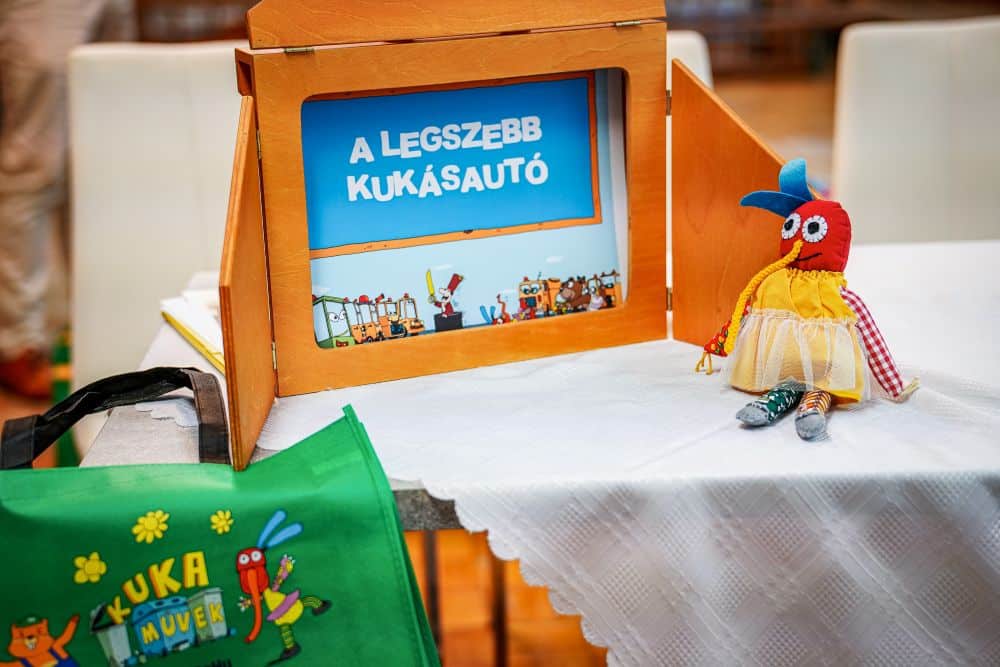
The stories can also be performed using kamishibai, a Japanese form of paper theatre that works with framed illustrated boards. This technique has become increasingly popular in Hungarian kindergarten pedagogy in recent years because it combines visual and spoken storytelling and holds the attention of small children well. Every story in the programme has its own original illustration, so the paper theatre performance delivers a coherent, self-contained experience.
Every member kindergarten of MIÓVI joins the pilot
During the 2026/2027 school year, MiReHu will support all member institutions of MIÓVI, the Miskolc Integrated Kindergarten Institution, with the programme’s materials. The pilot serves a dual purpose: to help establish environmentally conscious thinking in an experience-based way suited to the children’s age, and to give kindergarten teachers a methodological tool that fits easily into everyday educational work.
That second consideration is often decisive in practice. Many awareness-raising materials never become part of daily pedagogical work because they add workload, require separate preparation, or do not fit the group’s daily routine. A monthly package of stories delivered with finished illustrations and a ready performance format is designed to keep that barrier to entry low.
Logistics are part of the concept too. The first month’s stories were handed over to the institutions at the press conference, and in the months that follow MiReHu’s waste collection colleagues will personally deliver the subsequent stories and related materials to the kindergartens. The arrangement also carries a symbolic message: the staff who collect the waste become the face not only of the service but of environmental education as well, in the eyes of the children.
What storytelling pedagogy has already achieved within MaKuka
Stories are not new to MiReHu’s toolkit. Building on storytelling pedagogy, the company produced its own children’s book, and in 2026, on World Read Aloud Day, it brought the tale Múki and the Black Kingdom to children as part of a programme that attracted national attention. The story was read aloud to local kindergarten children by the staff who carry out waste collection, and 150 kindergarten groups received the book as a gift.
The success of these earlier programmes, together with the interest shown by both children and kindergarten teachers, created the opportunity for a further international good practice to join MiReHu’s awareness-raising work.
What was said at the launch
The programme was presented at the first management meeting of MIÓVI’s 2026/2027 school year, in the framework of a press conference. József Tóth-Szántai, Mayor of Miskolc, noted that MiReHu consistently comes forward with innovative initiatives that would hold their own not only in Miskolc but anywhere in Europe. He said it was especially gratifying when such innovation meets children and awareness-raising, and stressed that protecting our environment and the planet is one of our most important tasks – at least as significant as the values and outlook we pass on to our children.
Roland Ladányi, Managing Director of MiReHu Nonprofit Kft., emphasised that for the company, environmental education is not a simple task but a long-term mission. He said that building environmentally conscious thinking is worth starting in childhood, which is exactly what the MaKuka programme has been working towards for years. The new initiative offers a further opportunity to put more experiences and new methodological tools into the hands of kindergarten teachers. He described it as a particular pleasure to bring to Miskolc’s children a successfully operating programme created in Norway by a specialist with ties to the city.
Anna Tótth-Szamosi, the creator of the method, said her aim in developing it was to talk to children about environmental protection in a way that felt like an appealing, exciting story rather than a school subject. Stories make it easier for children to connect with the messages, she said, and paper theatre adds a special quality to the performance. She described it as a great joy that the programme can now come home to Miskolc and reach kindergartens where environmental education already plays an important role.
From pilot to a nationally applicable model
MiReHu’s experience is that local, personal and experience-based awareness-raising has a stronger effect on children – and, through them, on families. That indirect mechanism matters particularly in waste management: the quality of separate collection ultimately depends on household-level decisions, and within the family, children are often the most effective communicators.
The pilot now getting under way therefore represents more than a new opportunity for Miskolc’s kindergartens; in the longer term it could lay the foundations of a model applicable nationwide. If the programme succeeds, Kuka Művek could in future join kindergarten environmental education across every region of Hungary – making the Miskolc initiative the first step towards a broader, national awareness-raising programme.
Kindergarten environmental education – frequently asked questions
What is the Kuka Művek programme?
Kuka Művek is an environmental education programme developed in Norway with state support for children under the age of ten. It is built on twenty interconnected stories that treat environmental protection and sustainability in a playful, easily understandable form. The stories can also be performed using paper theatre, and every one of them has its own original illustration.
Which kindergartens in Miskolc are taking part?
During the 2026/2027 school year, MiReHu Nonprofit Kft. will support every member institution of MIÓVI, the Miskolc Integrated Kindergarten Institution, with the programme’s materials. The rollout takes the form of a pilot project, aiming both to establish environmentally conscious thinking in a way suited to the children’s age and to give kindergarten teachers a usable methodological tool.
Who created the programme?
The method was developed in Norway, with state support, by Anna Tótth-Szamosi – better known as Zöld Panna. A Hungarian mother of three with ties to Miskolc, her aim was to talk to children about environmental protection through appealing, exciting stories rather than as curriculum material. With this rollout, the programme effectively returns to the city she is connected to.
How do the kindergartens receive the stories?
The first month’s stories were handed over to the institutions at the press conference. In the months that follow, MiReHu’s waste collection colleagues will personally deliver the subsequent stories and related materials to the kindergartens. This monthly handover is both a logistical solution and an awareness-raising gesture, bringing the staff who collect waste into direct contact with the children.
What is kamishibai and why is it used?
Kamishibai, or paper theatre, is a Japanese storytelling form that works with framed illustrated boards, combining visual and spoken narration. It has grown popular in Hungarian kindergarten pedagogy in recent years because it holds the attention of small children well. Every story in the programme has its own original illustration, so the performance delivers a self-contained experience.
Source:
