





If you like our site, mark us as a preferred source on Google — so you’ll see our articles more often in search!
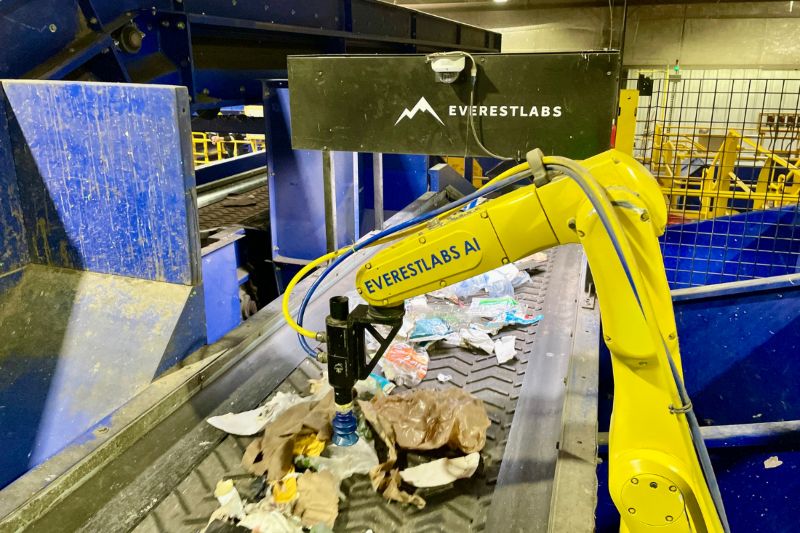
★Mark us as a preferred sourceOn August 24, 2026, EverestLabs announced the launch of a multi-agent AI platform purposely built for material processing, recovery, and recycling facilities. Unveiled in Fremont, California, this innovation provides a massive operational upgrade to one of the largest, yet least-digitized sectors of the global materials economy.
A New Era for Material Processing Facilities
EverestLabs Navigator provides plant operators with real-time operational intelligence and immediately acts on it to improve efficiency, throughput, and financial performance across facilities handling plastics, fiber, and metals. Moving well beyond static dashboards, the platform relies on specialized AI agents that monitor equipment health and coordinate systems in a continuous closed loop. Trained on billions of data points, it effortlessly processes chaotic and highly variable material flows at millisecond speeds. Furthermore, the system plugs directly into existing plant control networks and older, legacy equipment without requiring expensive retrofits or destructive production halts.
The system uniquely brings together three distinct layers of AI that have never operated as one unified system on a materials economy facility floor:
-
Edge vision models that classify material directly at the sorting belt.
-
Vision-language models (VLMs) that interpret each material stream in its proper context.
-
Reasoning and conversational agents that recommend and take direct actions. This granular intelligence extends facility automation far beyond standard robotic sorting, allowing AI agents to orchestrate complex equipment and entire operational workflows seamlessly.
The technology fundamentally alters the profit-and-loss statements for material processing plants by providing the following quantitative benefits:
-
Boosting Throughput Up to 30%: By mitigating material flow problems and minimizing idle belt time, the platform can boost a facility’s capacity by 20-30%, thus directly increasing top-line revenue.
-
Saving Millions Through Reduced Downtime: The AI agents track anomalies to predict belt or equipment failure. By catching issues before they happen, facilities save millions of dollars in avoided downtime and spare parts.
-
Preventing Costly Losses to Landfills: Legacy sorting equipment often results in valuable plastics, metals, and fibers ending up in landfills. The platform pinpoints these losses and optimizes the machinery to increase the reuse of valuable commodities.
-
Simplifying EPR Compliance and Regulatory Audits: The platform continuously monitors material composition and tracks facility-level recovery and residue rates. This data is critical for complying with Extended Producer Responsibility (EPR) regulations and stringent municipal contracts.
Industry Partnerships and Leadership Perspectives
R. Paul Singh, CEO of EverestLabs, stated, “The next great frontier for AI is in the scrap yards, recycling and waste streams that underpin our industrial economy. By deploying Physical AI to recover the 93% of raw materials we currently never reuse, we’re not just boosting recycling—we’re building supply chain sovereignty.”
EverestLabs, the company that previously created RecycleOS, is collaborating with early customers like Caglia Environmental and global industry partners such as Schneider Electric and Pellenc ST. JD Ambati, Founder and Chief Strategy Officer, highlighted that the platform serves as an AI process engineer, data analyst, and controls specialist for operators who have historically relied on manual guesswork.
Corey Stone, Plant Manager at Caglia Environmental, praised the system for removing the guesswork and making their MRF a fully AI-run and managed plant. Jean Henin, CEO of Pellenc ST, emphasized the crucial need for intelligent synchronization between optical sorters and purpose-built AI. Additionally, Pierre-Emmanuel Cotte of Schneider Electric noted that the platform perfectly bridges operational technology with AI-driven decision-making, enabling continuously optimized autonomous operations at scale.

FAQ
What is EverestLabs Navigator?
EverestLabs Navigator is the first multi-agent (agentic) AI platform purposefully built for material processing, recovery, and recycling facilities to provide real-time operational intelligence and equipment orchestration.
What AI technologies are included in the platform?
The platform combines three layers of AI: edge vision models for classifying materials at the belt, vision-language models (VLMs) for contextual interpretation, and reasoning/conversational agents that make recommendations and execute actions.
Can the platform improve recycling facility capacity?
Yes, by mitigating material flow bottlenecks and idle belt time, EverestLabs Navigator can boost a facility’s throughput capacity by 20% to 30% while preventing costly downtime by predicting equipment failures.
References:
